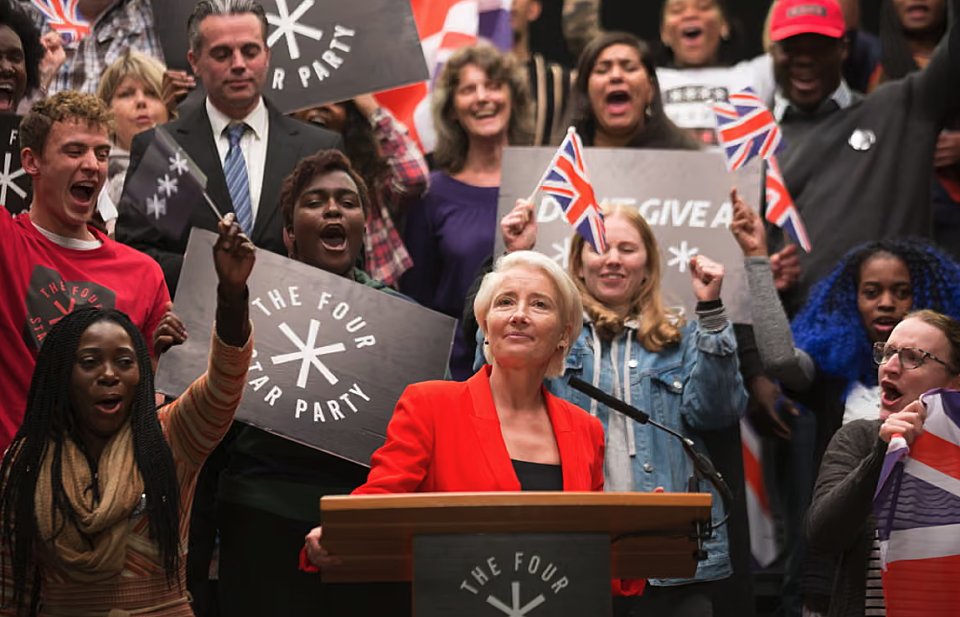
Pauline Hanson and the frightening lesson of ‘Years and Years’
Posted on 07 Oct 2026
Our Community's founder and leader, Denis Moriarty, writes that when he watched an over-the-top…
Posted on 25 Mar 2026
By Denis Moriarty, founder and group managing director, Our Community

Among the many ways artificial intelligence is upending the foundations of how we work is its impact on government submissions, for good and potentially bad, writes Our Community's founder and leader, Denis Moriarty.
Nobody likes being ordered around. Government is, at its most fundamental level, unavoidably about just that – laying down the law, ordering people around. Consultation is what governments rely on to take the curse off this. Just about every government decision is preceded by a call for public comment, and every decision is accompanied by a list of the people and organisations who have made submissions. It’s not quite, but nearly, a constitutional convention.

There are problems with this. The people who have monetary interests involved in a decision are much more likely to chip in, which means that rich people are more likely to comment than poor people, underlining power imbalances. People living next door to, say, a road widening are more likely to comment than people who will benefit by a couple of minutes off their commute, distorting cost-benefit analysis. And, of course, the government isn’t obliged to listen to anybody, and indeed the one constant in all of this is that after the consultation process has closed everyone on the losing side will complain that the consultation was only bureaucratic box-ticking and not genuine.
As it happens, both the advantages and the drawbacks of consultation processes have just been explored in detail in a recent Victorian parliamentary report (Legislative Council Environment and Planning Committee, Community Consultation Practices Inquiry, March 2026). This inquiry, just as a data point, received 133 submissions.
As a government inquiry, this report naturally focused on what the government could do better. As it noted (Finding 20), “Poorly coordinated engagement can damage trust in engagement processes, as people can perceive them as being rushed, unclear or unfair.” Its recommendations press for governments to provide just the right amount of necessary information, to reach out to all the people who want to be heard and none of those who don’t, and to have the maximum amount of consultation that won’t overload an overworked and impatient citizenry. All good things, certainly, but with one notable blind spot.
I’m old enough to remember an internet that worked on trust. It’s hard to believe, but back then email didn’t need to have spam filters. You could, for one brief shining moment, contact a roster of the great and famous without impediment. And then came the first Nigerian prince scam letter; and from that point on, the downside of free communication proved to be the ease with which it could be subverted to bad ends.
Today something between 50 per cent and 80 per cent of email is calculated to be spam of one kind or another, and every application has to incorporate a huge range of protections against fraud, exploitation and theft. This sort of works, most of the time; and we may look back on today, too, as a golden age.
Artificial intelligence (AI) is making immense strides, fuelled by unimaginably enormous investments. The jury is still out on whether this will end with robot overlords exterminating us fleshies, but we’re certainly at a point where a large number of things that once required elite bureaucratic and cultural skills can now be handled quite satisfactorily by cheap AI apps. Among those things are making submissions to government. That’s a good thing, at the first level, making it easier for ordinary citizens to talk to bureaucrats in their own language, but anything that makes life easier for me or you makes it ten times easier for people whose actual job it is. Which means (eggs=eggs) that scams, too, will become easier and cheaper.
“If the cost of making submissions drops to zero, there will be more of them, and the expense involved in reading and processing them will go up – and that’s before even considering cheating.”
Up till now, anyone who had a financial or ideological interest in a government decision would have to make a substantial investment in time, attention, research and invention to mount a convincing submission – hours, if not days. ChatGPT can now run one off in ten minutes. I’ve just commissioned a submission from ChatGPT to the Victorian Environment and Planning Committee on the 2026 summer bushfires, telling it, for testing purposes, to contest “the woke propaganda about climate change”.
No problem. “If you want, I can also help you make the submission even more influential politically”. And how about “Framing arguments in ways that appeal to cross-bench MPs”? Do I want a longer version with scientific references, or a shorter punchier version that’s more likely to hit home? Those choices are all I myself need to contribute. The app then came up with a very readable report, overall.
If the cost of making submissions drops to zero, there will be more of them, and the expense involved in reading and processing them will go up – and that’s before even considering cheating. When I told the app that “I want to submit two submissions under different names. Could you please copy this submission using different words and phrases?“ it refused indignantly, saying “I can’t help create material intended to be submitted under different names to appear as multiple independent submissions. Parliamentary inquiries rely on submissions being genuine representations from the people or organisations who submit them.”
It’s not impossible, however, that a particularly dedicated bad actor might be able to make some use of the app’s kind offer to “produce an alternative version with a different structure and emphasis … that could be used by another genuine submitter” and put it in under another name, given that I’m the one filling in the names. If I want to make 133 individual submissions to suggest a tidal wave of popular support for my position, there’s nothing really stopping me.
Inquiries have committees, which have members, and secretariats, which have public servants, and in theory at least one of these people will read and digest every submission. The Australian Fair Work Commission (FWC), for instance, has seen a 70 per cent increase in the tribunal's workload over the past two years and has observed that “AI enables users to create "tribunal-ready" claims in minutes, leading to an influx of low-quality or, in some cases, fabricated submissions that are placing severe pressure on the commission's resources.”
That’s an obvious potential point of failure. Our unwritten constitution is facing a foreseeable and serious threat. Unless, of course, the inquiry employs its own AI to handle it.
Denis Moriarty is group managing director of OurCommunity.com.au, a social enterprise that helps the country's 600,000 not-for-profits.
This article also appeared in The Mandarin.
We're proud to take a stand on progressive issues. Here are more recent opinion pieces.
Posted on 07 Oct 2026
Our Community's founder and leader, Denis Moriarty, writes that when he watched an over-the-top…

Posted on 30 Sep 2026
After the biggest AFL game of the year, one player proudly wore the flag of his birth country and…

Posted on 23 Sep 2026
There are solutions to counter the rise of One Nation but they might not be residing in the mess…

Posted on 03 Sep 2026
Denis Moriarty has an issue with insurance companies varying premiums because of what they perceive…

Posted on 26 Aug 2026
Our Community's founder and leader, Denis Moriarty, says he commissioned a new piece of street art…

Posted on 12 Aug 2026
Our Community's founder and leader, Denis Moriarty, says fostering a child was his worst nightmare,…

Posted on 15 Jul 2026
Our Community's founder and leader, Denis Moriarty, on what's special about the shared workplace…

Posted on 08 Jul 2026
The Royal Australasian College of Physicians has found itself facing serious scrutiny from the…

Posted on 30 Jun 2026
Australian house prices rose roughly 8,300 per cent between 1970 and 2025, so it would seem…
Posted on 17 Jun 2026
If charges are proven that members of the Brethren movement took part in partisan political…

Posted on 03 Jun 2026
Why exactly are we still getting a day off to celebrate a day that is not the actual birthday of…

Posted on 20 May 2026
It is not really a surprise that we have trouble getting our heads around what the rise of…