
NFP tech experts urge orgs to scale up cybersafety
Posted on 15 Oct 2026
Good cybersecurity must be the foundation of not-for-profits’ efforts to adopt artificial…
Posted on 17 Feb 2025
By Matthew Schulz, journalist, Institute of Community Directors Australia

An analysis of all Australian grants has revealed that total spending on grants distributed by federal, state, council and philanthropic sources is about $125 billion each year, according to the best estimate.
Data scientists for SmartyGrants – which is part of the Our Community group of social enterprises and shares offices with the Institute of Community Directors Australia (ICDA) – have done the analysis.
But before you read on, be warned that this elusive figure is not as straightforward as it appears. There are good reasons why no one else in Australia has identified it, with different funding bodies tracking spending in a variety of ways.
The total figure has bounced around dramatically over the four years SmartyGrants has tracked spending, as follows:
The figures above are rounded to the closest whole number to avoid “false precision”.
In the 2022 financial year, grants leapt by about 30% from $102 billion to just under $129 billion as Australian governments tackled the covid-19 fallout and provided disaster relief. Funding then dropped to just over $112 billion in 2023, before rising again to nearly $125 billion in the last financial year.
Of the billions that funders spend on grants, only about a quarter allow for competitive selection processes.
“This figure serves as a basis for comparison with other countries and could help evaluate how effectively funds are being distributed.”
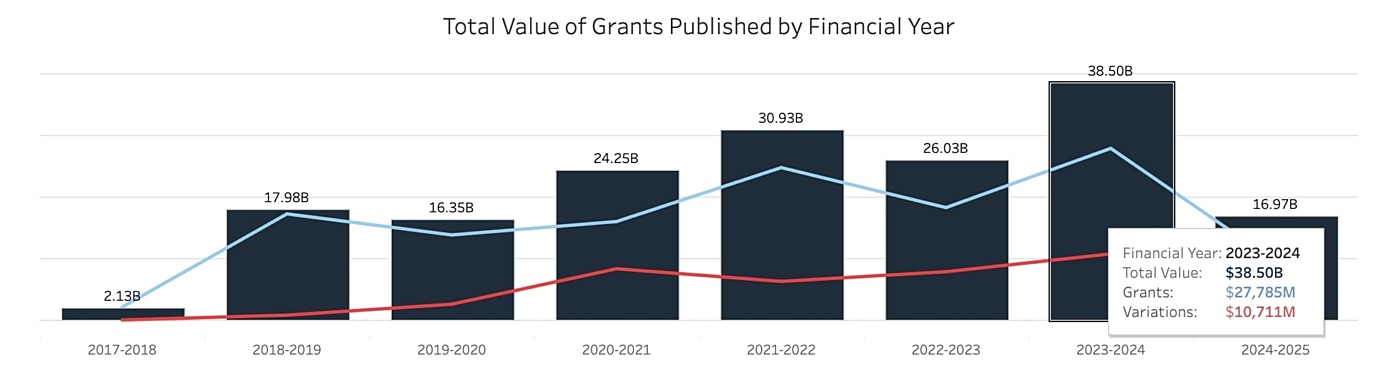
Not surprisingly, the biggest spender on grants nationally is the federal government, which dished out $38.5 billion in funds in the 2024 financial year, including a massive $10.7 billion in variations in the past year.
SmartyGrants can be more confident about federal spending figures than other figures, since the Commonwealth has required granting bodies to report their grants to the GrantConnect service since 2021. Of that federal money, 29% is provided through competitive funding via “open competitive” (11%) and “demand driven” (18%) grants.
The federal government’s grant spending has varied markedly in recent years, partly as a result of the pandemic, and partly as a result of the policy settings of the Morrison and Albanese governments. Federal grant funds have been the subject of numerous inquiries and reports by grants watchdogs, including the federal auditor-general. Earlier this year, the Australian National Audit Office (ANAO) suggested that nearly half of federal grants programs failed to adequately follow proper processes.

Grants doled out by state and territory governments for the 2024 financial year, based on state and territory budget statements, totalled as follows:
Comparing the SmartyGrants analysis with state and territory revenues shows that most states allocated between a fifth and a quarter of their revenue to grants, although South Australia spent the least at 15%. By population, the biggest spenders on grants per capita were the Northern Territory, Tasmania and the ACT, while the lowest spender was again South Australia.
The other big grant spender in Australia is philanthropy, which spent $10 billion on grants and donations, according to an extrapolation of the most recent count by the Australian Charities and Not-for-profits Commission (ACNC). A more detailed breakdown of previous spending can be read in this report.
Finally, SmartyGrants’ analysis estimates that local governments spent more than $155 million on grants in the past year, although the true figure could be higher, given the difficulty in tracking spending across the country’s 537 local government areas LGAs).
As mentioned, nailing down the figures is no simple feat, given the fact that different jurisdictions count the figures in different ways, some combine grant spending with other budget items, and there is a risk of double counting.
SmartyGrants scientist Nathan Mifsud said the estimate was a work in progress, but the lack of official data had prompted SmartyGrants to conduct its own analysis for the benefit of its users, and for funders of all kinds.
“It’s important for understanding how much taxpayer money is being allocated through grants, especially the share that’s available to non-governmental organisations,” Dr Mifsud said.
“This figure serves as a basis for comparison with other countries and could help evaluate how effectively funds are being distributed.”
But he said interpreting the figures was a challenge, partly because government spending is funnelled through several levels. For example, federal spending could be allocated to a state, which could allocate funds to a local council, which could then grant money to a community group which actually spent the money.
“Government expenditure isn’t always broken down in ways that are easy to follow, and there’s no single database that tracks all grants from start to finish. We’ve had to make educated guesses, especially when it comes to determining the proportion of total funding that is open or competitive.”
Dr Mifsud said the estimate drew on a range of public sources as well as SmartyGrants’ own large dataset.
Posted on 15 Oct 2026
Good cybersecurity must be the foundation of not-for-profits’ efforts to adopt artificial…

Posted on 15 Oct 2026
A few years ago, I sat on a small community board that was still held together by email threads and…

Posted on 15 Oct 2026
“Build a better mousetrap, and the world will beat a path to your door”, the old saw goes.…

Posted on 15 Oct 2026
The nation's digital inclusion advocate is pushing for more equity in the rollout of AI in light of…

Posted on 15 Oct 2026
Not-for-profit leaders should be conducting regular “fire drills” that replicate AI-powered…

Posted on 15 Oct 2026
Boards that leave cybersecurity to the one director with IT expertise are leaving their…

Posted on 15 Oct 2026
Community Directors has a warehouse-style office filled with artworks, and if I glance up towards…

Posted on 15 Oct 2026
As the manager of a palliative care service, Stephanie Kirkman Meikle has learnt that the prospect…
Posted on 14 Oct 2026
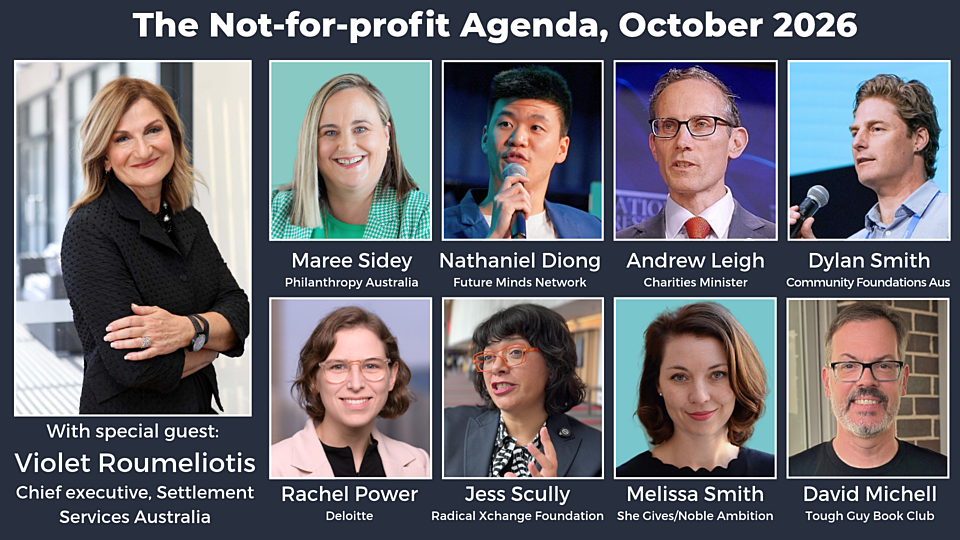
A special guest with her finger on the pulse of one of the biggest issues facing Australia –…
Posted on 17 Sep 2026
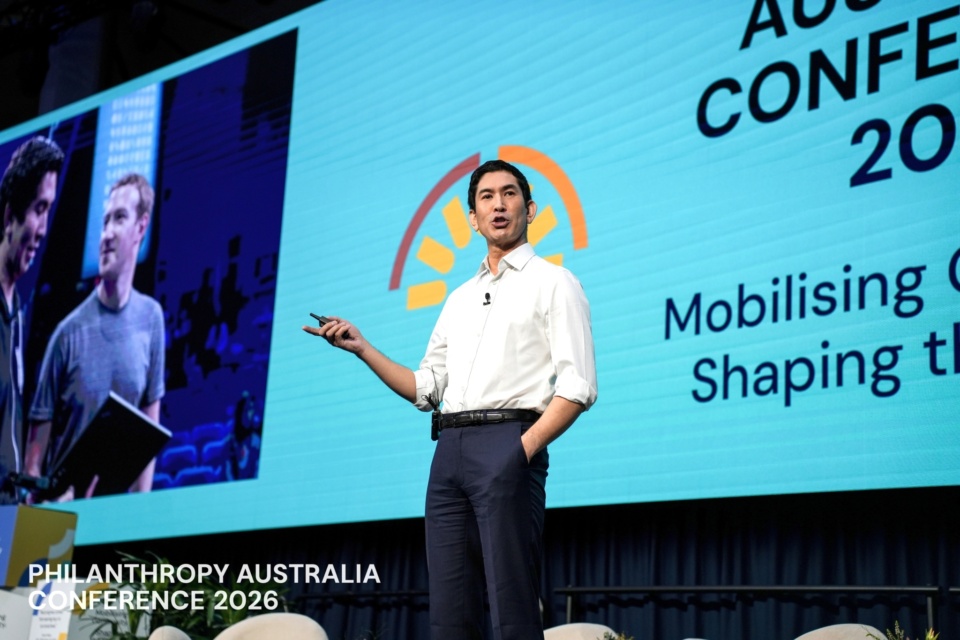
Australia’s biggest gathering of philanthropists, which drew more than 1200 delegates to Brisbane…
Posted on 17 Sep 2026
Experts in Australian philanthropy say there are stark differences between philanthropic money and…

Posted on 17 Sep 2026
One of Australia’s foremost fundraising observers says Australian not-for-profits must get the…