
Philanthropists ask: Can we forge a better future?
Posted on 17 Sep 2026
Australia’s biggest gathering of philanthropists, which drew more than 1200 delegates to Brisbane…
Posted on 03 Dec 2025
By Matthew Schulz, journalist, Community Directors
Many not-for-profit (NFP) board members in Australia are burnt out, overwhelmed and considering stepping down, according to the first national study of board member wellbeing.
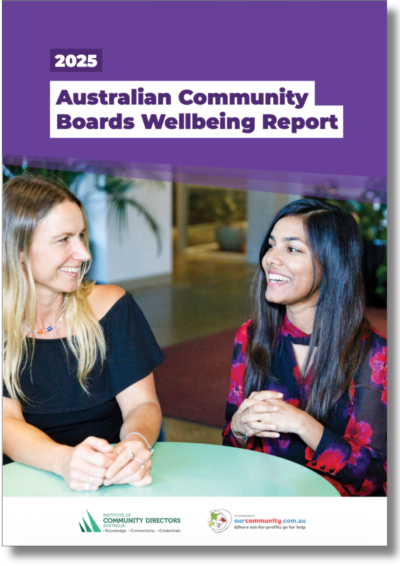
The 2025 Australian Community Boards Wellbeing Report, just published by the Institute of Community Directors Australia (ICDA), has lifted the lid on the emotional and governance pressures facing volunteer board directors.
The survey of 575 board members and NFP leaders across Australia found that while the vast majority (89 per cent) of respondents felt strongly aligned with their organisation’s mission or were confident about their effectiveness (75 per cent), more than two-thirds had considered stepping off their board because of stress or overwhelm.
One board member summed up the contradiction: “It’s not that the work is bad, it’s that there’s too much of it and never enough people to help.”
Another respondent said: “I’ve seriously thought of quitting more than once due to constant pressure and no recognition.”
The report stands as a stark warning to not-for-profits not to take talent for granted, as people drawn to the sector for the right reasons are worn down by the strain. The study found that 83 per cent of respondents felt fulfilled by their board service, but 72 per cent reported experiencing stress as a result of that work “always”, “often” or “sometimes”.
Chairs were identified as carrying the heaviest burden. More than half (52 per cent) reported frequent stress from a workload combining preparing for meetings, leading discussions, managing internal dynamics and ensuring compliance.
The chair of one mid-sized organisation said they were “overworking due to others not meeting their time commitments”.

Other board members expressed frustration with poor leadership and blamed poor chairs for contributing to stresses.
“No leadership! Meetings are micromanaged, no discussion about crucial matters,” one said. Others described chairs who were “keen on having a title” but unwilling to lead productive conversations, and a chair who “like[s] to let people know he has a doctorate”.
Strong chairs, by contrast, were a protective factor. “As chair, if there appears to be unrest, I will meet privately with those directors to resolve those issues,” one respondent said. “We are a happy lot who work toward the comfort of the residents we represent.”
Many respondents nominated administrative and regulatory workload as excessive and unmanageable, especially for small, volunteer-led boards. Time commitment (nominated by 58 per cent), governance complexity (48 per cent) and interpersonal conflict (35 per cent) emerged as the top three causes of stress.
“Governance feels like a maze. I didn’t realise how much compliance and risk we’re responsible for,” one board member wrote.
Another said, “We don’t need mental health support, but we do need assistance in protecting board members from ever increasing regulation and associated liability risks. To the extent there are mental health issues on boards, that issue is a key root cause. Fix the problem not the symptoms.”
Other board members believed compliance was overwhelming the mission. One said: “Governance is important, but sometimes there’s more than necessary to the point of creating work that distracts from other important matters.”
One placed that issue in a wider context: “The problem is a function of a society that seems not to value volunteerism and a bunch of governments who keep increasing complexity (and, I feel, legal liability) to the extent that I intend to get out of such positions as soon as I can.”
The data also showed clear differences in stress patterns across organisations of varying sizes. Board members from organisations with less than $250,000 in annual income were the most likely to experience high levels of stress, with 34 per cent reporting they were frequently or always stressed. These boards often lacked basic structures such as formal inductions, conflict management processes, or role clarity.
“I’m overworking due to others not meeting their time commitments,” one respondent wrote. “We have too few board members, which means shouldering a huge load.” Just 21 per cent of board members from tiny organisations reported having an adequate induction, and 88 per cent said their organisation had no wellbeing policy at all.
Another theme that emerged strongly was the lack of formal wellbeing systems and policies. Only 16 per cent of respondents said their board had a wellbeing strategy, and just 13 per cent had wellbeing as a standing item on their board agenda.
As one respondent wrote: “We tick the safety boxes, but wellbeing isn’t on the agenda – literally.”
Even where wellbeing was acknowledged as important, many respondents said they didn’t know how to act on it. “We need help to turn awareness into action. Everyone agrees it matters, but no one knows what to do next,” said one.
In larger organisations, the main stressors were cultural: personality clashes, power imbalances, and lack of skilled chairing, for example.
“We tick the safety boxes, but wellbeing isn’t on the agenda – literally.”

Boards are also spreading workload pressures onto staff, especially in smaller organisations.
“I have now worked with three similar organisations as executive director and all of them are in the same situation, lack of sufficient funding, resulting in unreasonable expectations of each board/committee in the paid employee (myself). One role resulted in complete burnout for myself. The board did not recognise, acknowledge or take any responsibility for this.”
The report also revealed significant variation in how boards manage culture, conflict and workload, and while 79 per cent of respondents felt comfortable speaking up to disagree, one in five did not, and 35 per cent said interpersonal conflict was a key stressor.
“We have a chair who dominates every meeting – it’s hard to speak up, and harder still to disagree,” one respondent wrote. Another said, “I feel like I can’t ask questions I need to ask to be able to fulfil my duties, not getting information I need to be able to fulfil my duties.”
Among respondents who reported interpersonal conflict as a major source of stress, only 43 per cent believed their board was good at managing that conflict. Nearly one in three of these respondents said they weren’t confident about remaining on the board in the next 12 months – a signal that unresolved interpersonal tension may contribute to board churn.
Still, the report stresses that stress is not inevitable. A notable 28 per cent of board members reported experiencing no or only rare stress in their roles. These low-stress boards shared common traits: clear induction processes, efficient meeting practices, defined roles, and chairs who were described as inclusive, respectful and well-prepared.
One chair said: “We have a policy that it is not personal and always leave the board showing respect for each other. If there appears to be unrest, I will meet privately with those Directors to resolve those issues. I address the expectations of behaviour with new Directors and so far have not encountered any problems.”
The boards of larger organisations (generating more than $10 million in revenue) reported the lowest rates of stress, with those organisations more likely to have formal policies on well-being and related issues.
According to one respondent, better run and resourced organisations were most able to improve board members’ wellbeing.
They argued that “board stress [is] exacerbated by limited resources and frustrated efforts to achieve [the] mission in a grant-dependent environment when shrinking funds are available”. Those boards faced higher stress through “disenchantment, disillusionment and frustration” which led to resignations, further compounding the problem.
The same respondent also argued that in contrast: “In a vibrant, active organisation it is easier to recruit additional board personnel, reducing the workload, increasing diversity and skill … reducing the stress of existing board members”. The respondent supported improved induction, professional development and policy assessments.
The report includes a series of practical recommendations aimed at boards, chairs, funders and policymakers:
The report also calls on funders to treat board wellbeing as critical infrastructure. “Funders, governments and sector leaders should recognise the human cost of volunteer governance,” the authors write. “They should support initiatives that reduce the burden on individual directors and ‘pay what it takes’.”
Importantly, wellbeing isn’t just about mental health. The authors argue it is a governance and retention issue. When board members feel respected, supported and prepared, they are more likely to stay in their role and govern effectively. That stability has a direct impact on the sustainability of the organisation.
ICDA executive director Adele Stowe-Lindner said the good news was that there were many ways to ease board member stress.
“The data shows that board challenges are not inevitable, and solutions already exist within the sector,” she said.
“I hope this report will serve as a baseline for measurement in future years as well as provide practical actions organisations can take in the short term to increase their own sustainability and that of the community sector as a whole”.
Learn more at our official webinar launch (Wednesday, December 17)
Posted on 17 Sep 2026
Australia’s biggest gathering of philanthropists, which drew more than 1200 delegates to Brisbane…
Posted on 17 Sep 2026
Experts in Australian philanthropy say there are stark differences between philanthropic money and…

Posted on 17 Sep 2026
One of Australia’s foremost fundraising observers says Australian not-for-profits must get the…
Posted on 17 Sep 2026
As direct giving dries up, charities face growing dependence on big donors and negotiating the…

Posted on 17 Sep 2026
Charities reported $14.8 billion in donations and bequests last financial year, the second-highest…

Posted on 17 Sep 2026
My father often googles my name, and as a result, years ago, I received a surprising gift in the…
Posted on 17 Sep 2026
Where Evelyn Mugisha grew up in rural Uganda, the subjects and careers considered suitable for…
Posted on 09 Sep 2026
A global gathering of philanthropists in Brisbane this week is aiming to tackle society’s biggest…
Posted on 09 Sep 2026
Media attention about women's philanthropy has more than doubled in three years, according to new…
Posted on 26 Aug 2026
Sector leader Violet Roumeliotis has called on funders to stop treating not-for-profit…

Posted on 13 Aug 2026
As a teenager, I attended summer camp for seven years, first spending two weeks at a time camping…

Posted on 13 Aug 2026
Not-for-profits are full of people with great ideas, but that doesn’t mean they are set up for…