
Save Izzy: campaign calls on government to restore funding for vital services directory
Posted on 07 Oct 2026
A major public campaign launched this morning is calling on the federal government to restore…
Posted on 22 Oct 2025
By Nick Place, journalist, Community Directors
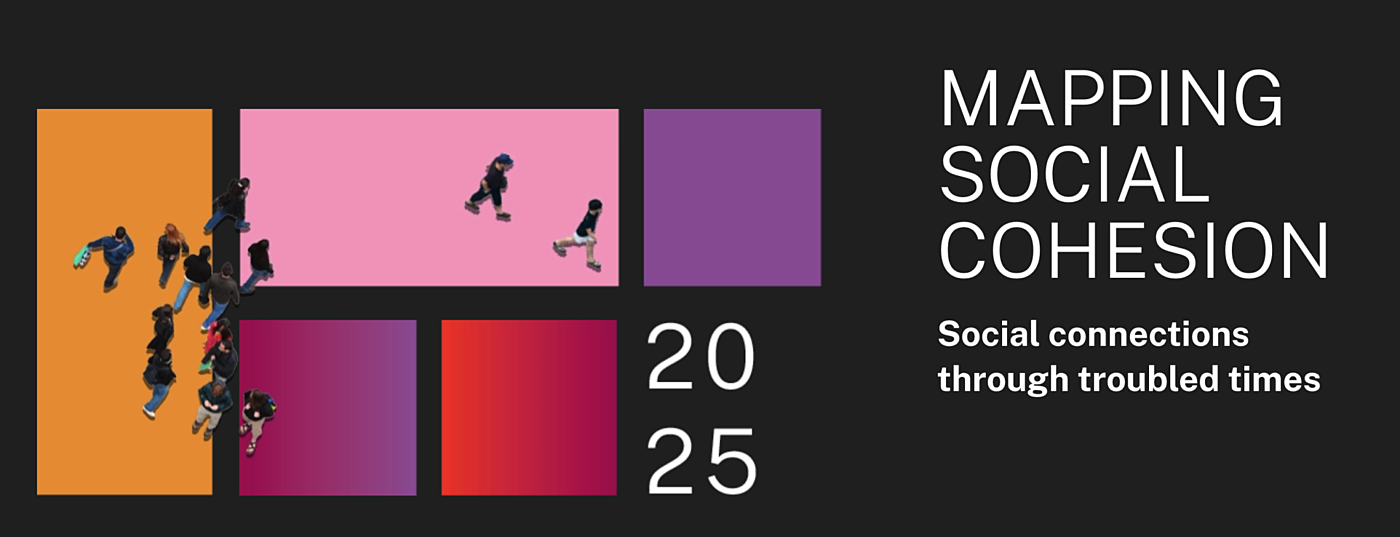
The Scanlon Foundation Research Institute’s 2025 Mapping Social Cohesion report has confirmed that for the third year in a row, Australia’s neighbourhoods are the secret weapon holding the nation together.
One of the authors, the Australian National University’s Dr James O’Donnell, said it showed that Australian communities were continuing to show “remarkable resilience”.
“Local connections – whether through neighbourhoods, workplaces or community groups – are the glue holding our society together. Even in the face of uncertainty, most Australians continue to report happiness and a strong sense of community,” he said.
“More than 80 per cent of Australians agree that their neighbours help each other and get on well together from different backgrounds, while 54 per cent are actively involved in social, community and civic groups.
“When people have a strong sense of cohesion in their local areas, their trust, belonging and acceptance of our differences and diversity has been much more resilient through these challenging times.”

The report is the most comprehensive ongoing profile of social cohesion in Australia, published last week for the 19th year in a row, and it shows that social cohesion remains impressively steady, although there are warning signs within the data.
The Institute’s CEO, Anthea Hancocks, told the Community Advocate last week that women, young people and neighbourhoods were the key to Australia’s cohesion remaining strong despite the difficult global conditions, and that the report was important because it dug beyond daily headlines about extremism to reveal what Australia’s silent majority was thinking and feeling.
Nevertheless, the 2025 report does suggest strains in belonging, trust and identity, particularly among younger Australians and those facing financial hardships.
The number of Australians who reported feeling “a great sense of belonging” was down to 46 per cent of those surveyed, from 63 per cent in 2020 – although the figure has remained steady since 2023. Of Millennials and Gen Z’s surveyed, fewer than one in three reported a great sense of belonging – a finding that the researchers connected to higher levels of social isolation in society today.
The report was published shortly before this year’s Australian Unity Wellbeing Index, released yesterday. The index has served as a barometer of Australians’ sense of wellbeing and satisfaction with their lives for a quarter of a century.
Launching the index, produced by Australian Unity and Deakin University, Charities Minister Andrew Leigh said it was important to ask Australians the question: how satisfied are you with your life?
“Local connections – whether through neighbourhoods, workplaces or community groups – are the glue holding our society together. Even in the face of uncertainty, most Australians continue to report happiness and a strong sense of community.”
He said the index echoed the government’s Measuring What Matters framework, a national wellbeing dashboard that indicated health, security, sustainability, cohesiveness and prosperity measures.
“The 2025 [Australian Unity Wellbeing] survey captures both optimism and strain,” he said. “Personal wellbeing has held steady, with a small rise to a score of 68. National wellbeing has lifted more strongly, up three points to 55, reflecting improved satisfaction with government and the economy.
“It is striking that these gains come despite a testing year of cost-of-living pressures, natural disasters, and international turmoil. Australians seem to be separating their sense of national direction from their private anxieties, perhaps seeing signs that the country is on a better path even as personal budgets remain tight.

“Both datasets, the Measuring What Matters dashboard and the Australian Unity Index, point to the same conclusion: that wellbeing is multi-dimensional, interdependent and uneven. And both exist for the same reason: because what we measure shapes what we strive to improve,” he said.
The Mapping Social Cohesion report revealed financial pressure as the biggest threat to social cohesion, with 40 per cent of Australians describing themselves as “just getting along”, “struggling” or “poor”.
“[P]eople who we observe have been ‘just getting along’ at best for three or more years are much less likely to report being happy, to trust in the Federal Government or people generally or to believe their neighbours help and get along with each other,” the report found.
The survey also showed a disturbing weakening in Australia’s collective enthusiasm for multiculturalism. It identified social and economic pressures as a reason for a fall in the number of Australians who agreed that “diversity makes Australia stronger”, from 78 per cent in 2023 to 67 per cent in the latest report.
Sixty-seven per cent of Australians agreed racism is a “fairly or very big problem”, but at the same time, the report revealed rising prejudice and discrimination against religious and ethnic groups.
“We can’t take multiculturalism or social cohesion for granted,” Dr O’Donnell warned. “The results show that social inclusion and belonging – particularly for younger people and those doing it tough financially – and the difficult experiences faced by migrant and cultural groups require ongoing attention from governments, workplaces and communities alike.”
Institute CEO Anthea Hancocks said, “Social cohesion is not static – it changes as our circumstances do. This year’s findings show that while Australians continue to draw strength from their communities, many are feeling the strain of affordability and global uncertainty. Supporting belonging and confidence in the future remains vital to our national wellbeing.”
More information
You can explore the Mapping Social Cohesion report here.
Posted on 07 Oct 2026
A major public campaign launched this morning is calling on the federal government to restore…
Posted on 07 Oct 2026
The Australian Literacy & Numeracy Foundation (ALNF) has announced a partnership with mining…
Posted on 07 Oct 2026
A conference in Darwin will this morning hear detailed, strategic plans for how Australia could…

Posted on 30 Sep 2026
Not-for-profit leaders have been warned to be wary of approaches from potential “funding partners”…
Posted on 30 Sep 2026
More than 200 fully funded Centre for Social Impact (CSI) scholarships will help equip for-purpose…

Posted on 30 Sep 2026
Personal stories are among the most powerful tools a charity can have to raise funds and awareness,…
Posted on 23 Sep 2026
A just-released major global survey of charities has found that demand for charity assistance has…
Posted on 23 Sep 2026
Fresh from welcoming delegates to last week’s Philanthropy Australia conference in Brisbane,…
Posted on 23 Sep 2026
A national strategy to develop Australia's regional cities is needed to break the housing…

Posted on 23 Sep 2026
Eight years after a report to Treasury first suggested the charities regulator should be more…

Posted on 17 Sep 2026
Australia’s biggest gathering of philanthropists, which drew more than 1200 delegates to Brisbane…
Posted on 16 Sep 2026
A new partnership between Paul Ramsay Foundation (PRF) and Atlassian Foundation aims to attract…