
NFP tech experts urge orgs to scale up cybersafety
Posted on 15 Oct 2026
Good cybersecurity must be the foundation of not-for-profits’ efforts to adopt artificial…
Posted on 18 Sep 2025
By Matthew Schulz, journalist, Institute of Community Directors Australia

For decades, the humble org chart has dominated the ways we visualise organisations. It shows who reports to whom, who sits where, and how authority flows. It is hierarchical, rigid, and often outdated the moment it is drawn.
But as we keep hearing, we are entering an era where AI agents – autonomous digital colleagues – will sit alongside us as true collaborators. With that, the org chart starts to look clunky.
According to McKinsey & Company’s recent podcast episode “The Future of Work is Agentic”, we will move towards the work chart: a living map of people and agents, tasks and flows. Not just “who you report to,” but “how work actually gets done.”
At the same time, thinkers in technology and business strategy are reimagining the Spotify model of product development – one underpinned by collaboration, transparency, and simplicity – for the human–AI enterprise. In a recent CIO article, experts described how the model could evolve to include composite teams, liquid workflows, and “cognitive meshes” (shared knowledge), integrating humans and AI agents seamlessly.
So what does this mean for fundraising organisations?
IBM defines agentic AI as “an artificial intelligence system that can accomplish a specific goal with limited supervision. It consists of AI agents – machine learning models that mimic human decision-making to solve problems in real time”.
Agentic AI is not just about generating content, as we have come to expect from chatbots. Agentic AI systems can:
For fundraisers, this opens powerful possibilities:
The critical point is that AI becomes a teammate, not just a tool. Just as Spotify “squads” (teams) once mixed product managers, developers and designers, the fundraising squads of the future will mix fundraisers, data experts and AI agents.
"The critical point is that AI becomes a teammate, not just a tool."

Here are examples of what fundraising work charts could look like for organisations of different sizes. Instead of static boxes and lines, think of nodes (humans and AI agents) connected by flows (tasks, feedback, and collaboration).
Today: One person wears multiple hats – grant writing, donor calls, social media, events
Tomorrow: human: development manager
AI agents:
Work chart flow: Human sets strategy and maintains relationships, while AI agents handle the paperwork and research.
Impact: Frees up the development manager’s time for what really matters – connecting with donors and telling the organisation’s story.
At my company, Equitable Philanthropy, we expect to help charities develop their funding strategy, then train AI agents on each organisation’s strategic plan, fundraising goals, and context. As agent capabilities develop, we can scale fundraising efforts so leaders spend more time developing relationships with funders and supporters.
Today: Fundraising is split into functions – grants, corporates, events, community. Silos emerge.
Tomorrow: Borrowing from Spotify’s squad model, we see composite teams:
Workflow: AI agents can flow between squads. If a corporate foundation opportunity emerges, a grant agent temporarily joins the corporate squad.
Impact: The organisation gains agility, adapting quickly to opportunities and reallocating capacity dynamically.
Equitable Philanthropy will design squad-based fundraising strategies tailored to team structures, introduce AI agents that work across functions, and train staff on managing workflows. Governance frameworks will ensure ethical, transparent and trusted adoption.
Today: Major silos – major gifts, annual giving, bequests, corporate, digital. Lots of duplication, little integration.
Tomorrow: Humans and AI agents form interconnected nodes:
Agentic governance layer: Ensures ethical AI use, data integrity and donor trust.
Impact: Fundraising shifts from managing silos to orchestrating a fluid ecosystem of people and agents. The system itself learns as it goes.
Equitable Philanthropy will support charities at this scale to integrate AI across multiple fundraising streams, build cross-team shared knowledge, and establish strong governance policies. We help boards and executive teams set guardrails so AI enhances performance without undermining donor trust.
This is not a simple plug-and-play future. Fundraising leaders will need to wrestle with:
These challenges are not blockers. They are design features – part of building an agentic fundraising organisation responsibly.
The future of fundraising does not entail replacing humans. It means freeing humans to do what only they can do: build trust, cultivate relationships and inspire generosity.
By shifting from static organisational charts to dynamic work charts, we reimagine how we organise ourselves:
Across the board, AI agents become collaborators – not just tools.
If you are a CEO, fundraiser or board member, consider:
In a world where work charts replace org charts, the organisations that thrive will be those bold enough to reimagine, yet wise enough to govern.
We are standing at the edge of a new fundraising era – one where humans and AI build bridges together. The question is not if this shift will happen, but how quickly each organisation will choose to step into it.
A version of this article was first published on Catherine Brooks’ substack.
Posted on 15 Oct 2026
Good cybersecurity must be the foundation of not-for-profits’ efforts to adopt artificial…

Posted on 15 Oct 2026
A few years ago, I sat on a small community board that was still held together by email threads and…

Posted on 15 Oct 2026
“Build a better mousetrap, and the world will beat a path to your door”, the old saw goes.…

Posted on 15 Oct 2026
The nation's digital inclusion advocate is pushing for more equity in the rollout of AI in light of…
Posted on 15 Oct 2026
Not-for-profit leaders should be conducting regular “fire drills” that replicate AI-powered…

Posted on 15 Oct 2026
Boards that leave cybersecurity to the one director with IT expertise are leaving their…

Posted on 15 Oct 2026
Community Directors has a warehouse-style office filled with artworks, and if I glance up towards…
Posted on 15 Oct 2026
As the manager of a palliative care service, Stephanie Kirkman Meikle has learnt that the prospect…
Posted on 14 Oct 2026
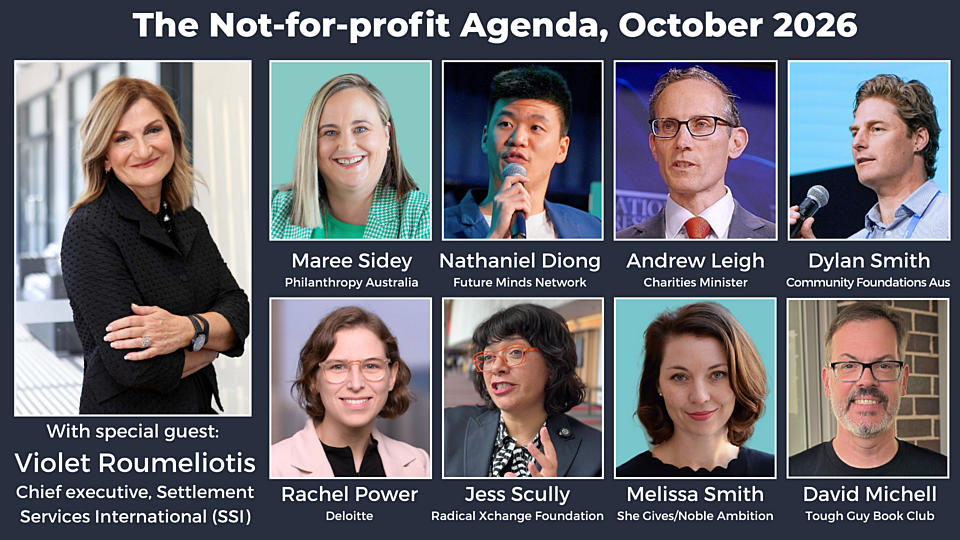
A special guest with her finger on the pulse of one of the biggest issues facing Australia –…
Posted on 17 Sep 2026
Australia’s biggest gathering of philanthropists, which drew more than 1200 delegates to Brisbane…
Posted on 17 Sep 2026
Experts in Australian philanthropy say there are stark differences between philanthropic money and…
Posted on 17 Sep 2026
One of Australia’s foremost fundraising observers says Australian not-for-profits must get the…