
25 years after Tampa, the politics of fear are still setting the terms
Posted on 14 Oct 2026
In the ongoing political debates about migration levels, Asylum Seeker Resource Centre founder Kon…
Posted on 31 Mar 2026
By David Crosbie, CEO, Community Council for Australia

This week during an interview I was asked why values and purpose are so important in our sector. My response was that values and purpose are fundamental for every sector. Values and purpose sustain and nourish our systems, our communities, our organisations, our families and ourselves.
Unfortunately, there are now many examples in Australia and around the world where the loss of values and purpose is obvious, which is why we all need to be particularly vigilant in our own organisations to ensure we stay on track.
Earlier this month, the National Anti-Corruption Commission (NACC) published its investigation report about the six individuals referred by the Royal Commission into the Robodebt Scheme.

The findings? “The Commission found that 2 of the 6 individuals engaged in serious corrupt conduct, and that the remaining 4 did not engage in corrupt conduct.”
Apparently only the two most junior officials referred to NACC bear any responsibility for wrongdoing because senior officials have nothing to gain through trying to please their minister.
The minister was told by advisers that legislation might be required to implement Robodebt, but he instructed the department to find a way to make significant social security savings without requiring any legislation. The senior officials then pretended no legislation was required for Robodebt – so they could meet their minister’s brief.
Reading parts of the NACC report is a perplexing experience, too strange and too verbose to outline in any detail here. It’s a fiction of postulation, inventing motives or lack of motives, and using these inventions to avoid finding that those most responsible should be held accountable. Here is just one paragraph, part of a longer explanation of why Kathryn Campbell (the former DHS Secretary) would not deliberately have deceived anyone because she was already very senior, had a great record, had nothing much more to gain in her career, and therefore had no motive, and without motive she must be innocent:
"Motive is no more an essential element of corrupt conduct within the meaning of the NACC Act than it is of a criminal offence. But just as in crime, so too with corrupt conduct, where the only motive for engaging in corrupt conduct is so improbable as to be near inconceivable, it comes so near to the point of proved absence of motive as to bespeak the absence of intent."
Many people suffered needlessly as an outcome of the actions of those who developed, implemented and maintained the Robodebt scheme. Innocent people died. But there is little to no accountability for government ministers who proudly promoted the scheme, or the most senior government officials who enabled and prolonged it.
“The most trusted leaders in our sector have invariably learnt not to compromise on purpose.”
This week’s ABC Four Corners program on the way universities have outsourced decisions to consultancy firms and the negative impact this has had on students and staff provided yet another example of purpose lost in false performance goals.
According to the ABC, Australian universities paid over $1.8 billion in consultancy fees to large multinational management consultancy companies in 2024. Partners and senior staff from these consultancies worked their way into universities (a target market) and became part of the management and governance structures. They applied an ‘education as a commodity’ lens to the functions of universities and implemented plans involving the sacking of hundreds of staff and cutting of hundreds of courses at universities including the Australian National University, the University of Wollongong, and the University of Technology Sydney. Not one of the vice-chancellors of these universities was prepared to be interviewed.
Again, the question for me is who is responsible or accountable for decisions that may be harmful or counter to the core purpose of an organisation, and how is that accountability exercised?
Most university staff are committed to education and developing our country through innovation and the increased realisation of human potential. Similarly, most senior government officials are dedicated to providing informative advice to governments, even if the advice they provide is not what governments might want to hear.
But in both the cases above there appears to be a clear loss of values and purpose.
Universities should not put profit before education. Public servants should not lie or mislead to please their minister. Ministers should not act unlawfully or deceive their Cabinet colleagues or the public.
For most charities and NFPs the values are clear, the purpose is clear, and there are effective governance and management structures that reinforce both. But what happens in our organisations when this is not the case?
The most common examples of charities losing their values and purpose tend to involve people in charities pursuing personal financial gain, sometimes illegally, or through various forms of nepotism, exploitation or other misconduct.
The reality is that while charities and NFPs invariably exist to benefit their communities, there will always be a very small minority of people who act in their own interests and harm others.
There is also constant pressure on charity and NFP leaders to give in to alternative goals, pursue income over purpose, take an easy road or shortcut, and seek to please rather than making a difference.
The most trusted leaders in our sector have invariably learnt not to compromise on purpose, not to turn a blind eye to minor misconduct or loss of values, to encourage through role modelling a clear focus on purpose, and to discourage misconduct through establishing and maintaining accountability, ownership, and responsibility.
Loss of values and purpose doesn’t happen overnight; it often creeps slowly via many small, barely noticeable steps until it finds a foothold, a way to undermine and insert new incentives, a way to drive decision making well beyond purpose.
Purpose and values matter, creating value matters, and being valued matters. All of these need our constant attention, especially in a world that seems to be drifting under a cloud of ego-driven nihilism.
David Crosbie has been CEO of the Community Council for Australia for the past decade and has spent more than a quarter of a century leading significant not-for-profit organisations, including the Mental Health Council of Australia, the Alcohol and Other Drugs Council of Australia, and Odyssey House Victoria.
Posted on 14 Oct 2026
In the ongoing political debates about migration levels, Asylum Seeker Resource Centre founder Kon…

Posted on 14 Oct 2026
Over the weekend, federal Liberal leader Angus Taylor told the Conservative Political Action…

Posted on 07 Oct 2026
Our Community's founder and leader, Denis Moriarty, writes that when he watched an over-the-top…

Posted on 30 Sep 2026
There's been a lot of talk about AI this week, and some of it has been frightening. So, is AI good…

Posted on 30 Sep 2026
After the biggest AFL game of the year, one player proudly wore the flag of his birth country and…

Posted on 23 Sep 2026
In his new book Our Place, policy expert Matt Lloyd-Cope argues that housing must be at the heart…

Posted on 23 Sep 2026
There are solutions to counter the rise of One Nation but they might not be residing in the mess…

Posted on 03 Sep 2026
Denis Moriarty has an issue with insurance companies varying premiums because of what they perceive…
Posted on 02 Sep 2026
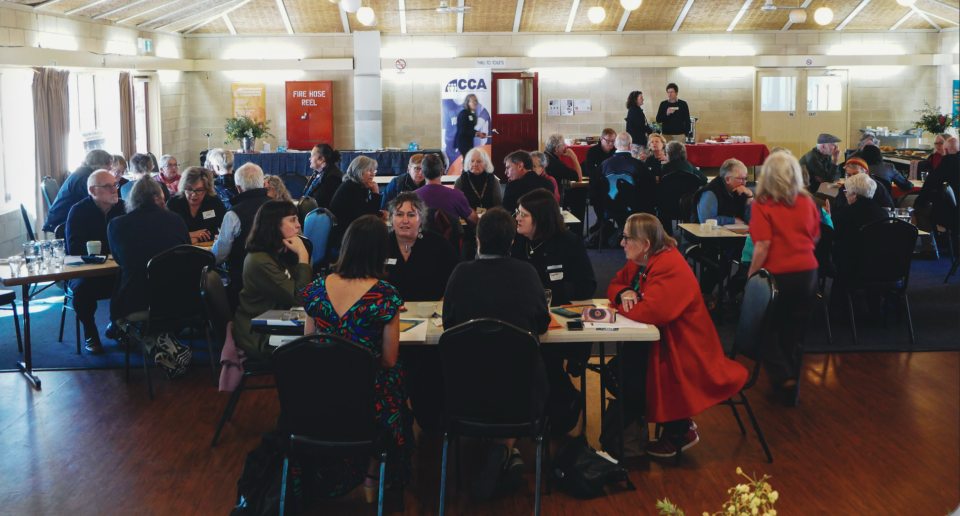
Yesterday, at a meeting just outside Castlemaine in Victoria, 70 people came together to hear…

Posted on 26 Aug 2026
Our Community's founder and leader, Denis Moriarty, says he commissioned a new piece of street art…

Posted on 19 Aug 2026
Government funding is at the centre of Australia's charity and not-for-profit sector – our number…

Posted on 12 Aug 2026
Our Community's founder and leader, Denis Moriarty, says fostering a child was his worst nightmare,…