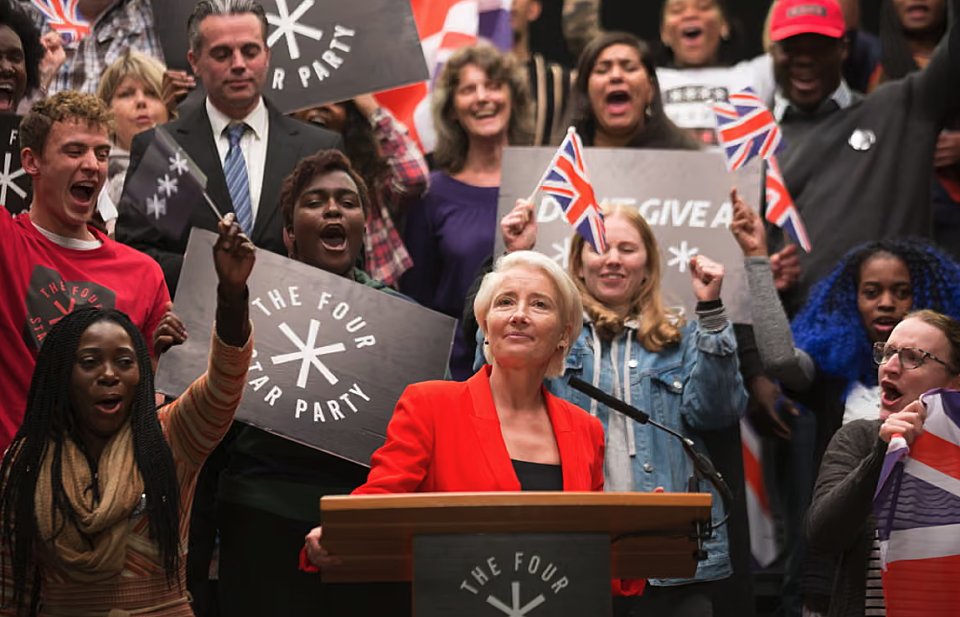
Pauline Hanson and the frightening lesson of ‘Years and Years’
Posted on 07 Oct 2026
Our Community's founder and leader, Denis Moriarty, writes that when he watched an over-the-top…
Posted on 08 Jul 2026
By Denis Moriarty, founder and group managing director, Our Community

The Royal Australasian College of Physicians has found itself facing serious scrutiny from the Australian Charities and Not-for-profit Commission, as well as other governance regulators. Our Community's founder and leader, Denis Moriarty, says the episode raises wider questions about whether the charity sector's regulatory systems are working.
In general terms, if a charity is facing concerns from the Australian Medical Council (AMC), the Australian Securities & Investments Commission (ASIC), Safe Work NSW, and the Australian Charities and Not-for-profits Commission (ACNC), it can be taken as a sign that something has gone wrong. The Royal Australasian College of Physicians (RACP) finds itself in this situation. It’s not at all clear, however, what precisely has gone wrong and what should be done about it.

The Royal College system provides a method of certifying medical professional qualifications – making sure that practitioners are properly registered and that they keep up with professional education, for example. The colleges combine these duties with acting as unofficial trade unions and poncing around in medieval robes and funny hats. The colleges are funded by member subscriptions from doctors and dentists who want to be able to call themselves Fellows and have post-nominals – letters after their name, like FRACP. At a couple of thousand a head, these subscriptions add up; the RACP runs through some $80 million a year.
The RACP’s latest adventures are the administrative equivalent of someone tripping over a cat while coming downstairs carrying a wedding cake. They involve a staggering three Extraordinary General Meetings (EGMs) in the last year (at about $200,000 a pop), unedifying personal antagonisms between the previous president and the president-elect, and competing allegations of bullying and undue influence. The outcome has been that the ACNC has intervened to displace the incoming president and substitute its own appointment – Susan Pascoe, the ex-head of the ACNC.
It takes a lot to bring the ACNC to intervene in the affairs of a charity. Its stated policy is that:
The ACNC does not directly intervene or mediate to resolve internal disputes. We respect the autonomy of charities and their ability to determine their own goals, strategies and how best to fulfil them. It is the role of each charity to manage, administer and accept responsibility for its own governance. To ensure that we do not impinge on the independence of charities, the ACNC refrains from taking an active role in mediating or resolving internal disputes.
It is particularly surprising, then, that this is not the RACP’s first rodeo. The ACNC struck down upon the college with great vengeance and furious anger back in 2019. Amid complaints of bullying and a toxic culture, the college entered into a voluntary compliance agreement with the ACNC to address:
…. concerns relating to board governance and culture. An ACNC investigation identified concerns that the RACP was not adequately meeting its requirements under the Governance Standards, specifically relating to accountability and transparency to members, and the duties of Responsible Persons … the RACP has agreed to engage a governance professional to review the charity’s board governance and culture, make recommendations for change, and then oversee the implementation of those recommendations.
It’s fair to say, then, that the Australian charity sector’s regulatory system has failed a major test. A major charity has been forced, quite rightly, into a process of reviewing and revising its unsatisfactory governance system and has nonetheless ended up with a new layout that’s just as unworkable as the old one.
All those concerned with the governance of Australian charities should be at least miffed. What went wrong?
“The RACP’s latest adventures are the administrative equivalent of someone tripping over a cat while coming downstairs carrying a wedding cake.”
There is an embarrassing surplus of possible explanations. Personal differences have brought down many much-loved community organisations, with long histories of feuds and obsessions forcing themselves into everything the board touches until all is lost. Personal styles can conflict – and a professional organisation where every member is accustomed to thinking of themselves as the smartest person in the room may be particularly prone to accusations of bullying, harassment and undue influence.
The technical issue that is said to underlie the antagonism between the supporters of the last president and the president-elect is whether or not the college should change its constitution to make it possible for someone other than the college president to chair the board (the old chair pushed for this, the new chair wants to stop it). One explanation of why this rule arouses so much acrimony is that supporters of a non-presidential chair – not, that is, directly elected by the members – are looking towards a more bureaucratic and less specifically medical model of governance, and medicos might find this threatening.
It’s still very difficult to see why or how this comparatively minor policy issue has been allowed to bring the College to the brink of collapse. In practice, the sheer administrative momentum of $80 million enterprises means that things like constitutional niceties – and even who is in the chair – have very little influence on actual votes in the board meeting. I think that a much more direct contributor to board dysfunction would be the provision that an EGM must be called if demanded by 5 per cent of the membership – 1,500 people, say – or, alternatively, 100 members, a number that may have made sense in 1936 when the college was founded but now amounts to a malcontent’s charter: but nobody is proposing to fix that.
In the light of the seething cauldron of competitive bullying claims, references to ‘toxic culture’, concerns about favouritism and personal dislikes, and a general breakdown in communications, the problems of the college seem to be governance-based only in the sense that governance has to be carried out by actual people who hate each other. No structures can guarantee smooth operation when virtually every board member for the past decade has brought their own monkey wrench to the party.
That, then, is the difficulty facing the government, the AMC, ASIC and the ACNC. It is impossible to write terms of reference of any regulator that would allow them to intervene whenever people feud. It would require an inspectorate larger than the Australian armed forces and more lawyers than one could shake a stick at, if that’s your idea of a good time. On the other hand, we can’t really allow the college to self-destruct in the way it wants to, because it’s an essential element in Australia’s medical arrangements.
We were lucky enough to find a way round this dilemma only because one of the various accusations and counter-accusations of bullying was upheld by Safe Work NSW, enabling the ACNC to call foul and put in its own nominee (which, I should make clear, is a much better outcome than the college deserves). Any other board faction seeking the overthrow of an election must consider the option of a similar one-two punch. The first one to Fair Work may have the advantage.
It is almost impossible to extract an improving moral from this omnishambles. The best I can do is, in the words of American cartoonist Alex Gilliland, “Some problems have no solutions, only consequences.”
Oh, and how in this electronic age can an AGM possibly cost $200,000?
Denis Moriarty is group managing director of OurCommunity.com.au, a social enterprise that helps the country's 600,000 not-for-profits.
We're proud to take a stand on progressive issues. Here are more recent opinion pieces.
Posted on 07 Oct 2026
Our Community's founder and leader, Denis Moriarty, writes that when he watched an over-the-top…
Posted on 30 Sep 2026
After the biggest AFL game of the year, one player proudly wore the flag of his birth country and…

Posted on 23 Sep 2026
There are solutions to counter the rise of One Nation but they might not be residing in the mess…
Posted on 03 Sep 2026
Denis Moriarty has an issue with insurance companies varying premiums because of what they perceive…
Posted on 26 Aug 2026
Our Community's founder and leader, Denis Moriarty, says he commissioned a new piece of street art…

Posted on 12 Aug 2026
Our Community's founder and leader, Denis Moriarty, says fostering a child was his worst nightmare,…

Posted on 15 Jul 2026
Our Community's founder and leader, Denis Moriarty, on what's special about the shared workplace…

Posted on 30 Jun 2026
Australian house prices rose roughly 8,300 per cent between 1970 and 2025, so it would seem…
Posted on 17 Jun 2026
If charges are proven that members of the Brethren movement took part in partisan political…

Posted on 03 Jun 2026
Why exactly are we still getting a day off to celebrate a day that is not the actual birthday of…

Posted on 20 May 2026
It is not really a surprise that we have trouble getting our heads around what the rise of…
Posted on 14 May 2026
Is it possible that Australians are revelling in demented hysteria at the moment, imagining all…