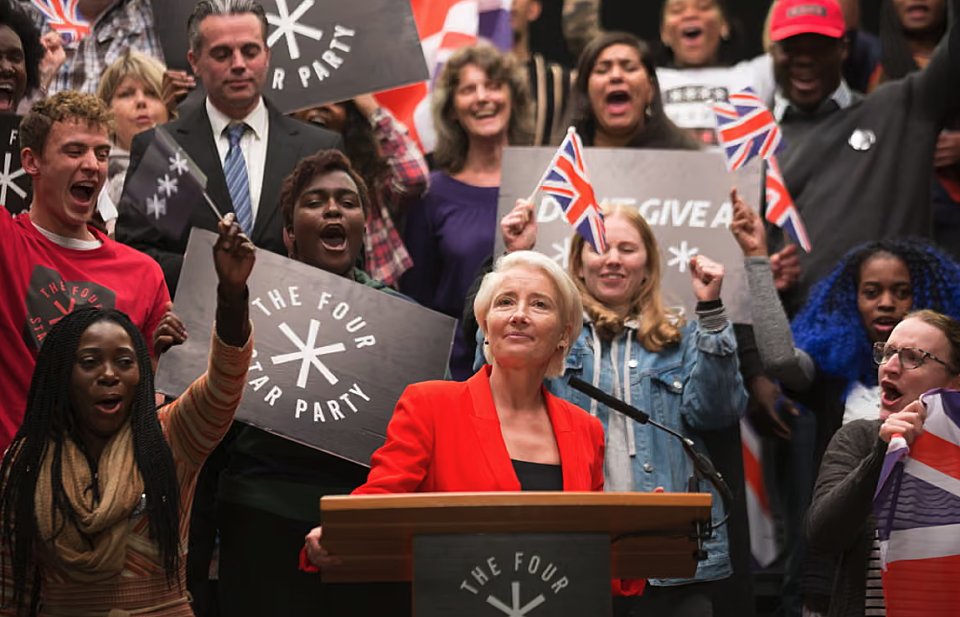
Pauline Hanson and the frightening lesson of ‘Years and Years’
Posted on 07 Oct 2026
Our Community's founder and leader, Denis Moriarty, writes that when he watched an over-the-top…
Posted on 10 Jun 2026
By David Crosbie, CEO, Community Council for Australia

In contemporary Australia, many of our essential services are not controlled by us. Our roads, energy infrastructure, airports, telecommunications networks and ports are no longer publicly owned. Governments sold these assets years ago, partly to strengthen short-term budgets, and partly on the back of an argument about the free market providing services more efficiently. The assumption was that government entities were not driven by the profit motive and were therefore less diligent in minimising their expenditure and maximising savings.
In many cases, these essential public assets are now controlled by offshore investment firms whose primary purpose is to generate returns for investors.
This control of many of our essential services is just one of many ways in which multinational companies affect Australia. We live in a global world. The products and services we rely on every day are often built from components, systems and expertise sourced from other countries. Even something as simple as writing this article on a computer depends on software, hardware, chips, connectivity and devices produced outside Australia.
And we are not just talking technology. Major luxury brands such as Louis Vuitton, Moët, Christian Dior, Sephora and Tiffany & Co now all sit within the same conglomerate company, LVMH. The economic power of some of these conglomerate companies to invest in a country or city is enormous.
The effect of large global corporations on our lives is not new, but their scale and influence now appears greater than ever.
International investor interests can challenge not only public interest, but also the authority of sovereign governments. This tension is visible in ongoing efforts by governments to put effective safeguards around the use and misuse of digital platforms, software, mobile applications and AI.
This is not to suggest that profit should be seen as a negative. Commercial success can align with the public interest by expanding economic opportunity, increasing government revenue, and improving the efficiency and quality of services.
However, the conflict between profit and public safety and benefit can be fundamental. It’s why we don’t let anyone sell a car that doesn’t have working brakes, or allow the marketing and sale of an untrialled drug that doesn’t work and has terrible side effects.
Of course, there are many more subtle examples where the tensions are quite complex. Should a telco be required to put up a tower and provide coverage for emergencies in a remote area where there is no opportunity for a commercial return?
When tensions arise between profit and public safety or benefit, we need three key elements: fit-for-purpose safeguards, appropriate regulatory controls, and effective enforcement.
Many charities and not-for-profits work at the intersection of for-profit providers and public benefit, pushing back against companies that do the wrong thing, and encouraging regulators to better protect consumers, our environment and our communities.
Some of our consumer advocacy charities rely on philanthropic support.
But what happens when the private trusts and foundations set up to support charities involved in this work are themselves sold off to international profit-making entities?
“The questions that need to be answered in this case, as in most of these cases, are what safeguards and regulations are in place, whether they are adequate, and whether they are well enforced.”
Perpetual Wealth Management is being sold to Boston-based Bain Capital Private Equity, a large private equity firm with more than US$220 billion in assets.
The sale includes Perpetual’s Licensed Trustee Companies, which manage around 1,200 charitable trusts and foundations with assets of more than $4 billion. Income from these charitable trusts is distributed to Australian charities and provides hundreds of millions of dollars in community benefit across the country.
This raises important questions because the transaction could affect the stewardship of significant charitable assets, the long-term distribution of funding to Australian charities, and the broader public benefit generated for communities across Australia.
The questions that need to be answered in this case, as in most of these cases, are what safeguards and regulations are in place, whether they are adequate, and whether they are well enforced.
Bain Capital may well be able to better manage charitable trusts in Australia, but how do we know, and what controls are in place?
Concerns have been raised in the past about licensed trustees in Australia and how they manage legacy funds left by people who wanted their money used to benefit their communities. Inquiries and considered recommendations, some now shelved, have included the federal government’s 2013 Administration of Charitable Trusts.
Bain Capital’s investment in Australian charities may prove beneficial, or it may not. At a minimum, however, it should prompt a serious discussion about whether Australia’s current regulatory and enforcement settings are strong enough to protect the intent of those who leave charitable funds in trustee companies for public good. Is regulatory oversight effective? Are management practices aimed at making profits for investors negatively affecting the public benefit the funds were meant to deliver?
Many aspects of our lives are now managed by global companies. Perhaps it was inevitable that this fact would eventually encroach into the management of charitable trusts, given their collective size and potential returns. Will generating profit and community benefit happily flourish together under this deal, or will public benefit lose out to the interests of international investors? CCA will be closely watching this space.
David Crosbie has been CEO of the Community Council for Australia for the past decade and has spent more than a quarter of a century leading significant not-for-profit organisations, including the Mental Health Council of Australia, the Alcohol and Other Drugs Council of Australia, and Odyssey House Victoria.
Posted on 07 Oct 2026
Our Community's founder and leader, Denis Moriarty, writes that when he watched an over-the-top…

Posted on 30 Sep 2026
There's been a lot of talk about AI this week, and some of it has been frightening. So, is AI good…

Posted on 30 Sep 2026
After the biggest AFL game of the year, one player proudly wore the flag of his birth country and…

Posted on 23 Sep 2026
In his new book Our Place, policy expert Matt Lloyd-Cope argues that housing must be at the heart…

Posted on 23 Sep 2026
There are solutions to counter the rise of One Nation but they might not be residing in the mess…

Posted on 03 Sep 2026
Denis Moriarty has an issue with insurance companies varying premiums because of what they perceive…
Posted on 02 Sep 2026
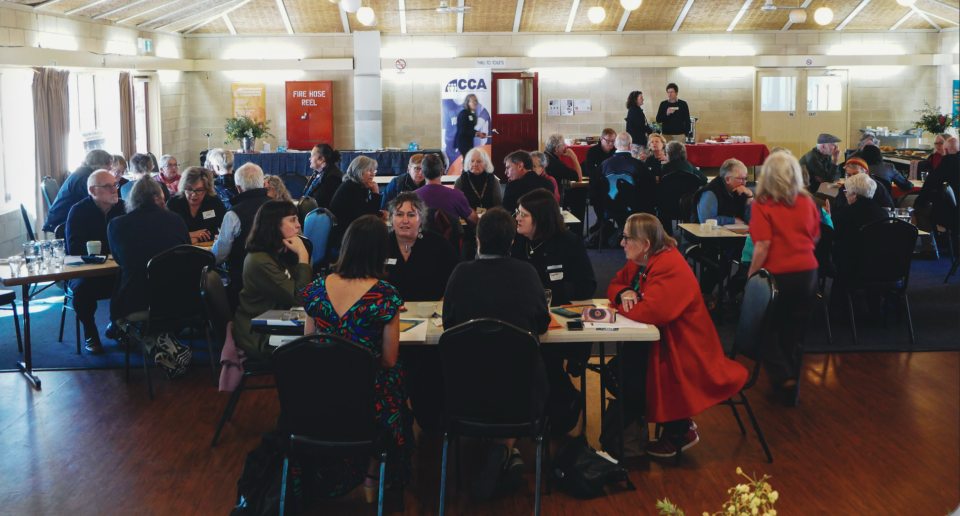
Yesterday, at a meeting just outside Castlemaine in Victoria, 70 people came together to hear…

Posted on 26 Aug 2026
Our Community's founder and leader, Denis Moriarty, says he commissioned a new piece of street art…

Posted on 19 Aug 2026
Government funding is at the centre of Australia's charity and not-for-profit sector – our number…

Posted on 12 Aug 2026
Our Community's founder and leader, Denis Moriarty, says fostering a child was his worst nightmare,…

Posted on 05 Aug 2026
The charity and not-for-profit sector is vital to our economy and the wellbeing of communities…
Posted on 05 Aug 2026
As the Global Impact Summit kicks off in Sydney today, Equitable Philanthropy’s Catherine Brooks…