Pauline Hanson and the frightening lesson of ‘Years and Years’
Posted on 07 Oct 2026
Our Community's founder and leader, Denis Moriarty, writes that when he watched an over-the-top…
Posted on 08 Apr 2026
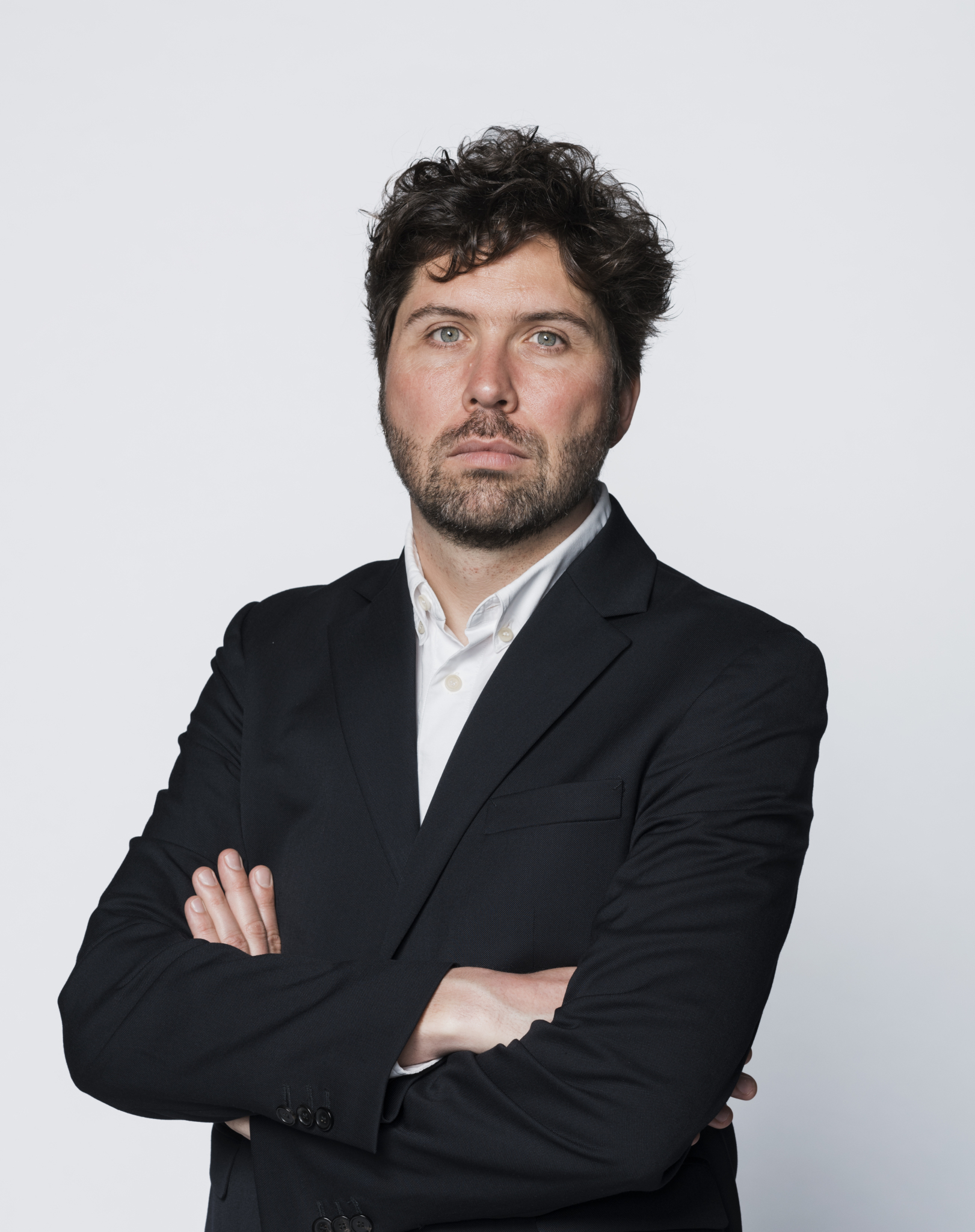
By Sean Kelly, Quarterly Essay
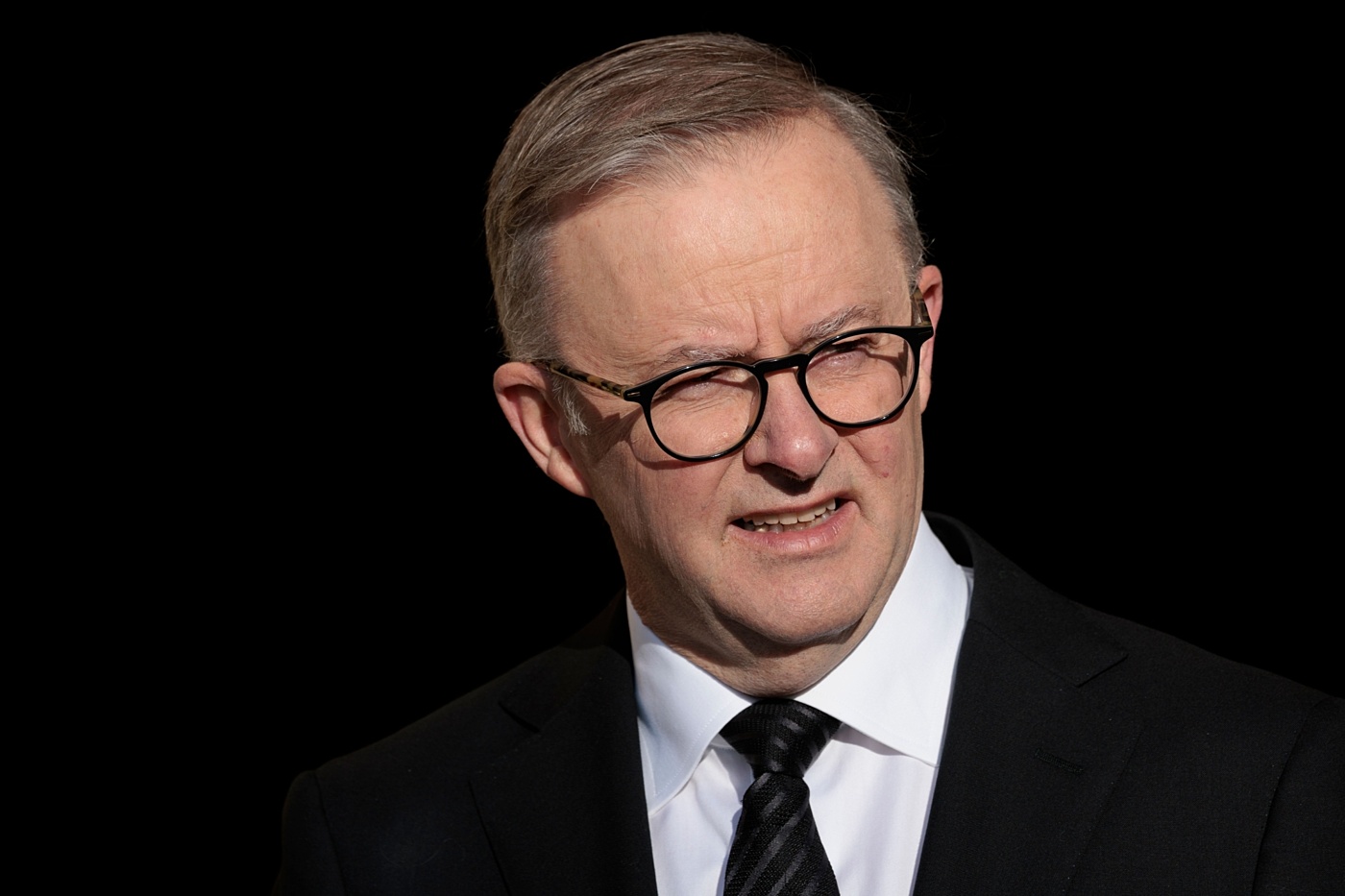
In the 100th issue of the Quarterly Essay, Sean Kelly asked questions of Labor, and specifically whether it is up for the good fight of changing Australia for the better. Do the government and the prime minister have the big ideas and the courage needed to fight entrenched interests? Here is an extract.
Again and again the government seeks the path of least resistance. Sometimes this means abandoning policies about which you think Labor might be more resolute. Before the 2022 election, Labor promised it would stop religious schools discriminating against LGBTQIA+ students and teachers. In government, though, it said it would not proceed without bipartisan support – which, predictably, it didn’t get. Labor walked away.
Or consider once more – because it is, after all, Australia’s intended contribution to fighting the greatest existential threat humanity faces – Albanese’s announcement of his emissions reduction target, just two months ago: “we think we’ve got the sweet spot. There will be criticism from some who say it’s too high, there’s some who will say that it’s too low.” This was not all Albanese meant by “sweet spot” – he meant, too, that the targets did something useful scientifically without damaging the country economically. But you don’t have to be glib about it to recognise that there is an identification, at either a conscious or an unconscious level – probably both – of “sweet spot” and landing right in the middle of opinion.
The perfection of this approach came in the lead-up to the government’s productivity summit. Early on, Jim Chalmers declared he was ready to “grasp the nettle” on tax reform. But as the summit approached, the government began talking down the idea of much coming directly out of it, certainly on tax.
The aim of the summit seemed to be to reach consensus. Albanese told the Australian, “If you had a choice between, do you have less things with more support, or more things with less broad support, then I’m in favour of the former.”
Consensus can be useful – but that is a genuinely striking statement, for the way it privileges the level of support for an idea over the quality of an idea or the importance of the problem being solved.
*
Where is Labor’s belief in all this? If you tried – on the basis of these statements and their accompanying actions – to deduce what the government believed, what would you conclude? I am reminded of a sentence from Paul Keating’s speechwriter Don Watson, written when Howard was prime minister and Labor was in Opposition: “They seem to think only what they think the people think.” How else to make sense of Chalmers’ repeated descriptions of the government as “middle of the road”? What other way is there to take Albanese’s claim that Labor represents the “vast majority of interests”?
In part, this is the result of a brutal electoral logic. Labor is sometimes accused of abandoning the working class, its original voting base and the cause which gave it purpose. This may be partially true, but it is also the case that the working class has changed; it is less monolithic, more dispersed, less unionised. Even if Labor wanted to – if it suddenly decided tomorrow that this would be its mission – there is no “working class” to which the party might return. This leaves Labor adrift, unsure who it represents, left standing for the “majority of interests.”
This is just one aspect of a broader fracturing of identity in our society. It was not so long ago that many people, perhaps most, thought of themselves as “Labor people” or “Liberal people.” Twenty years ago John Howard talked about this shift: in the 1960s, he said, 40 per cent reliably voted Labor, 40 per cent Liberal, with 20 per cent in the centre. The proportion of swing voters, he said, had doubled since then.
Today, the middle has grown further. At each election, a third of voters don’t even give their first vote to Labor and Liberal; presumably the number that don’t do so reliably is greater still. And this is part of a broader trend that has been developing for decades, most famously outlined in Robert D. Putnam’s book Bowling Alone. Once, people divided themselves up by their identities, tied to institutions, which were tied to beliefs. In Australia, people were mostly Catholics or Protestants. Perhaps they belonged to Rotary or the Lions. Those religious faiths had ties to the major parties. And these beliefs, identities and institutions were bound up in another form of meaning, which was community. That might sound like a vague concept, except that it did not only exist in some intangible sense but in the form of actual groups which met regularly: church groups, sporting clubs, party branches.
In recent decades, all this has broken down. To win over the growing numbers of uncommitted voters, political parties have developed two campaign strategies. Frank Bongiorno describes one approach:
"Political scientists developed the idea of the 'catch-all party,' which collects the support of various classes, cohorts and demographics in its endeavour to get a majority. The parties can only succeed in this endeavour by offering policies that often look disconnected and lacking in 'narrative' because each is calculated to appeal to a specific set of voters."
This is what we saw in the lead-up to the 2025 election, as Labor crafted policies to win the votes of particular groups: debt forgiveness for students, deposit help for first homebuyers. Neither addressed fundamental problems – university fees remained exorbitant and poorly designed, while the housing policy would in fact push up prices – but then that wasn’t the point.
The second approach is to offer policies which appeal to the broadest possible group – what used to be called the lowest common denominator.
Together, these result in a politics of the bland. The first does so by creating a thousand tiny policies, largely forgettable. The second discards anything that might offend.
*
What has happened to advocacy – to the belief that a central task of politics is changing people’s minds? Approaching the productivity summit, Chalmers said that if it failed, “It won’t be a shortage of courage, but a shortage of consensus.” This was a nice-sounding bit of nonsense: if there were consensus, then no courage from the government would be required.
In a 1990 phone call with journalist Laurie Oakes, Paul Keating said, “I’m in the crazy-brave category … You’ve got to stand for what you believe.” He told Oakes that inflation had to be broken, and that you couldn’t do it by gingerly sidestepping a recession. “I’m prepared to chance my hand and take the whole show to the wire.” Five years earlier he had made the case for a goods and services tax at a summit Hawke had called. Very publicly, Keating lost. Here is what he had to say about it: "I fought it out in the country and in front of the public under the cameras in a tax summit. I do not mind taking the losses. If the judgment is we cannot introduce a broadly-based consumption tax, that there is not enough public support and that the inflationary influences of its introduction were too much for the country and the fabric of the economy to stand, I accept that judgment; but the fact is I tried …"
Keating did, ultimately, concede, including to public opinion – but not before chancing his arm. We have here again the risk that excites – and that Albanese took on with tax cuts and the Voice. One success and one failure. And yet you get the impression that Labor is absolutely terrified of repeating its failure; and not sufficiently emboldened by its one successful fight to attempt such a thing again. It has not yet accepted – as any good government must – that failure is the price you must pay, more often than you would like, for pursuing your convictions.
Keating used to say he was in the “conflict business.” Years after politics he put it still more bluntly: “I’m not in the consensus business … Fuck consensus. I’m in the conflict business.” When he was still prime minister, he would invite ministers back to the Lodge to listen to Mahler, as a way of reminding them that, in the end, what they were doing amounted to “dust between the floorboards.” Therefore, he said, “Why would we take second quality decisions? Why wouldn’t we do better?”
The two positions are connected. If you want the very best outcome – not simply the one which you can convince most people to support – then conflict is inevitable. You may not win, but that is not the same as deciding not to fight.
*
“On occasion, you get a hint of the government’s willingness to resist the neoliberal mindset.”
There is another problem with the market-based approach to politics, the desire to give the people only what you think they want. This problem stems from the way that capitalism, in the form in which it exists now – that is, neoliberalism – seems to us the only possible system; that, in the words of theorist Mark Fisher, “it is now impossible even to imagine a coherent alternative to it.”
It is plausible – perhaps even likely, given the steady drop in the share of the vote going to the major parties – that many of us want something different from what we have. That is, more dramatic transformation than just a series of small improvements to existing mechanisms, step changes to the way things are already done. But it also seems as though we have stopped believing that such change is possible.
This isn’t about scrapping the system and starting again – some stubborn or forlorn utopianism. It is more localised than that. Can any of us imagine, anymore, really, a society in which we did not have what amounts to segregation in our schooling system, between rich and poor? In which private health funds, which we are penalised for not joining, did not rip us off? In which the things that matter most in our lives – childcare, healthcare, aged care, schooling – were not damaged and degraded by the profit motive, cost reductions, higher fees?
What if we have all stopped being able to conceive of what we want – not because we don’t want it, but because our imaginations have become limited, our language stunted? In this scenario, political parties might look like they were delivering what people want; they might even harvest a significant number of votes. But people’s unhappiness would continue rising. Their deepest desires would remain unfulfilled. Centre-left parties – those which traditionally traffic in hope – would appear oddly listless. And faith in our democracy, its institutions and its actors would continue falling.
One might think, in such a scenario, that it might fall to a party like Labor to do at least some of the imagining for the rest of us. It might even discover some political opportunity in this.
*
On occasion, you get a hint of the government’s willingness to resist the neoliberal mindset. One surprising achievement of the Albanese government is its restrictions on social media for children under sixteen. It was a clear decision; not an easy one; and, crucially, one founded on a moral viewpoint.
Many on the left expressed outrage; many landed on the impossibility of delivering the change, an oddly technocratic objection. As social psychologist Jonathan Haidt has pointed out, legislating creates an incentive. After all, he says, social media companies figured out how to hold auctions for online ads involving thousands of companies in the time it takes to load a webpage. “This is a miracle of technical innovation. And they did that because there was money in it. And now the question is: Do you think maybe they could figure out if somebody is under sixteen or over sixteen?”
In other words, here was a Labor leader refusing to take the objections of multi-billion-dollar corporations seriously and instead using the power of government to get businesses to do what they always say they are good at – innovating – in the name of something he judged important.
You can have rational discussions about the pros and cons of screen time. In the end, though, as the political writer Ezra Klein has said, there does not have to be a utilitarian reason. It is possible to say, “It’s just bad. I just don’t want you looking at the screen all the time. I think it’s not the way to be a human being.”
The reason Albanese’s intervention here is worth noting is this last point: it relates to the question that is always at the centre of politics, how to be a human being. Labor made a similar move by legislating for the “right to disconnect”: if you are at home, you do not have to be contactable by your boss. Both of these interventions are tied to visions of a good life – one that is significantly different from the “good life” to which neoliberalism has accustomed us.
In Albanese’s election-night speech in May 2025, he said:
"Today, the Australian people have voted for Australian values. For fairness, aspiration and opportunity for all. For the strength to show courage in adversity and kindness to those in need … Australians have chosen to face global challenges, the Australian way – looking after each other, while building for the future."
Amid the things any politician might say – “aspiration” and “courage in adversity” – there are some clear, compelling phrases that seem personal for Albanese: Looking after each other. Kindness to those in need. These are calls to conscience – demands for action similar to the “essentially religious” demand Coetzee described, to “drop everything and follow.”
I had a similar reaction – a recognition of morality in the midst of politics – when I heard Jim Chalmers defending Labor’s increase to JobSeeker payments in its first year. What worried the carping Coalition spokesperson, he said, “was that it meant that the broader Australian community would be funding help for the most vulnerable. That is the whole basis of social security.” For this clear line he received applause. It was a sharp argument. But the truth is that Labor’s increase to JobSeeker was fairly small, and only came in the face of sustained pressure. There has not been an increase to the rate since – outside mandated indexation – and those on JobSeeker still live in poverty.
Just occasionally, you have the sense that this Labor government knows what it wants to do. Or rather that, as Kafka suggests is true of all of us, it knows instinctively what it should be doing.
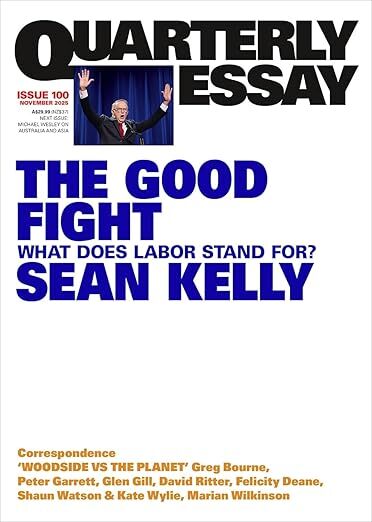
This is an edited extract of Sean Kelly’s Quarterly Essay The Good Fight: What does Labor stand for?, published by Black Inc.
Community Directors readers can receive a discount on Quarterly Essays by applying the code QE1007 for a $7 discount, plus the code FREESHIP for free shipping within Australia.
Sean Kelly is the author of The Game: A portrait of Scott Morrison, as well as a columnist for the Age and the Sydney Morning Herald, and a regular contributor to the Monthly. He is a former adviser to Labor prime ministers.
Posted on 07 Oct 2026
Our Community's founder and leader, Denis Moriarty, writes that when he watched an over-the-top…
Posted on 30 Sep 2026
There's been a lot of talk about AI this week, and some of it has been frightening. So, is AI good…

Posted on 30 Sep 2026
After the biggest AFL game of the year, one player proudly wore the flag of his birth country and…

Posted on 23 Sep 2026
In his new book Our Place, policy expert Matt Lloyd-Cope argues that housing must be at the heart…

Posted on 23 Sep 2026
There are solutions to counter the rise of One Nation but they might not be residing in the mess…
Posted on 03 Sep 2026
Denis Moriarty has an issue with insurance companies varying premiums because of what they perceive…
Posted on 02 Sep 2026
Yesterday, at a meeting just outside Castlemaine in Victoria, 70 people came together to hear…

Posted on 26 Aug 2026
Our Community's founder and leader, Denis Moriarty, says he commissioned a new piece of street art…

Posted on 19 Aug 2026
Government funding is at the centre of Australia's charity and not-for-profit sector – our number…

Posted on 12 Aug 2026
Our Community's founder and leader, Denis Moriarty, says fostering a child was his worst nightmare,…

Posted on 05 Aug 2026
The charity and not-for-profit sector is vital to our economy and the wellbeing of communities…
Posted on 05 Aug 2026
As the Global Impact Summit kicks off in Sydney today, Equitable Philanthropy’s Catherine Brooks…