
Philanthropists ask: Can we forge a better future?
Posted on 17 Sep 2026
Australia’s biggest gathering of philanthropists, which drew more than 1200 delegates to Brisbane…
Posted on 18 Sep 2025
By Matthew Schulz, journalist, Institute of Community Directors Australia

Canny not-for-profits must ensure they are well prepared before embarking on an artificial intelligence odyssey, tech experts say.
Social enterprise Infoxchange is in the midst of a major effort to educate 10,000 sector staff and volunteers in AI skills.
Since the training was launched early this year, NFP leaders and staff have shown a voracious appetite for the free courses.
Hundreds have already completed the training, which is available via Infoxchange’s Digital Transformation Hub, but momentum continues to grow, with Infoxchange this week announcing more comprehensive and structured training, supported by scholarships.
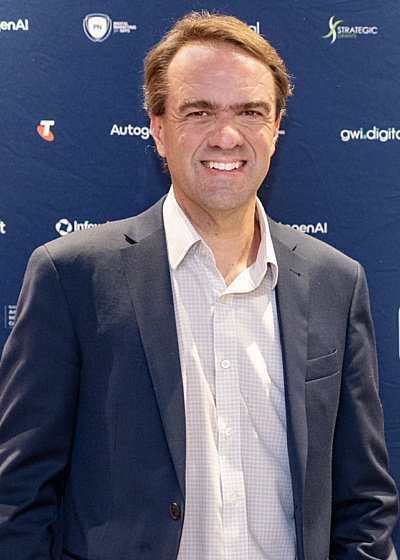
Infoxchange CEO David Spriggs said the training was part of a wider effort to ensure the community sector was not left behind as AI adoption continued to accelerate.
“AI offers extraordinary opportunities for the not-for-profit sector to amplify impact, streamline processes, and improve outcomes for communities.
“We know from our digital technology report that a portion of the sector is rapidly moving into this new frontier, but without the right technology readiness, organisational buy-in and ethical safeguards, many organisations will struggle to take full advantage of it.
“The challenge now is ensuring every not-for-profit has the tools and confidence to explore AI in a way that’s safe, strategic and sustainable,” said Spriggs.
“AI offers extraordinary opportunities for the not-for-profit sector to amplify impact, streamline processes, and improve outcomes for communities."

Infoxchange digital transformation manager Sophie Souchon said NFPs successfully navigating the rollout of AI had developed strong technological foundations and created an environment of organisational readiness before deploying AI tools.
She said those technological foundations included:
She said organisational readiness required:
Souchon said that each of these elements influenced the effectiveness of any AI “roadmap”, and by using them in combination, NFPs could protect data, act ethically, and align organisational goals with the use of new tools.
According to the most recent Infoxchange data, by mid-2024 76% of all NFPs were using artificial intelligence, up 52 per cent on the previous year.
Yet at the time of research, only a third were investing in AI, nearly a fifth of organisations were still hesitant to use it, and 42 per cent didn’t consider it a priority. A whopping 89 per cent hadn’t adopted policies to manage data or ethical risks.
She said that with organisations at so many different stages of readiness, AI adoption depended on a mix of factors such as resourcing, staffing, technology, leadership, IT budgets and organisational appetite.
“AI adoption is not a simple linear path,” she said.
But she said that not acting on AI was not an option.
“Staff will use generative AI, with or without permission. That’s why organisations need to provide guardrails, not just restrictions.”
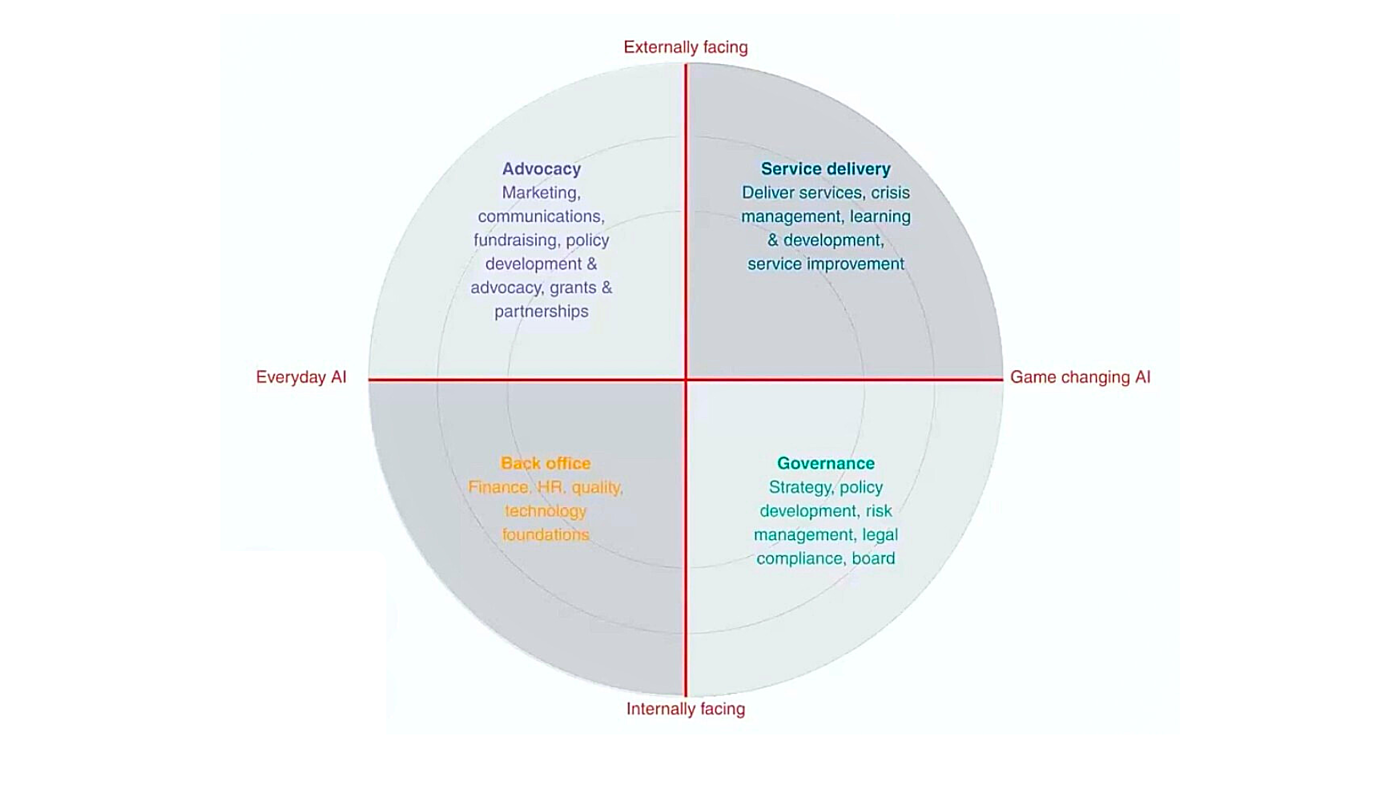
In a recent webinar on identifying AI opportunities, Souchon encouraged organisations to employ Infoxchange’s “AI not-for-profit opportunity radar”.
The radar “template” helps organisations consider various AI opportunities, spanning internal and external-facing applications, and tools ranging from everyday to “game-changing”.
Infoxchange nominated external-facingfunctions such as marketing, communications, fundraising, policy, advocacy, grants and partnerships as areas for “everyday” AI use.
“Game-changing” external uses could include service delivery and improvement, crisis management, learning and development.
Similarly, everyday back office functions such as finance and human resources could benefit from AI tools, while game-changing efforts could encompass risk management, legal compliance and board functions, she said.
Infoxchange’s multi-pronged strategy to improve the AI skillset of not-for-profits in Australia and the Asia Pacific has included:
NFP staff urged to get in quick to access $1.25m worth of AI scholarships
Infoxchange Asia-Pacific AI nonprofit learning community
Community Directors Intelligence: The AI edition
Community Directors artificial intelligence tools and resources
National Artificial Intelligence Centre’s AI standards, free courses, resources, and directory
ACNC: Guidance for charities considering AI
UK Charity Digital Skills report | ‘AI essentials’ video resources
Gradient Institute’s free AI training, resources and guidance
NFP Finance Week webinar replay: Catherine Brooks on AIs and fundraising
Posted on 17 Sep 2026
Australia’s biggest gathering of philanthropists, which drew more than 1200 delegates to Brisbane…

Posted on 17 Sep 2026
Experts in Australian philanthropy say there are stark differences between philanthropic money and…

Posted on 17 Sep 2026
One of Australia’s foremost fundraising observers says Australian not-for-profits must get the…
Posted on 17 Sep 2026
As direct giving dries up, charities face growing dependence on big donors and negotiating the…

Posted on 17 Sep 2026
Charities reported $14.8 billion in donations and bequests last financial year, the second-highest…

Posted on 17 Sep 2026
My father often googles my name, and as a result, years ago, I received a surprising gift in the…
Posted on 17 Sep 2026
Where Evelyn Mugisha grew up in rural Uganda, the subjects and careers considered suitable for…
Posted on 09 Sep 2026
A global gathering of philanthropists in Brisbane this week is aiming to tackle society’s biggest…

Posted on 09 Sep 2026
Media attention about women's philanthropy has more than doubled in three years, according to new…
Posted on 26 Aug 2026
Sector leader Violet Roumeliotis has called on funders to stop treating not-for-profit…

Posted on 13 Aug 2026
As a teenager, I attended summer camp for seven years, first spending two weeks at a time camping…

Posted on 13 Aug 2026
Not-for-profits are full of people with great ideas, but that doesn’t mean they are set up for…