
Don’t say nothing: why privacy is so important
Posted on 15 Oct 2026
Community Directors has a warehouse-style office filled with artworks, and if I glance up towards…
Posted on 22 Jul 2026
By Adele Stowe-Lindner, executive director, Community Directors

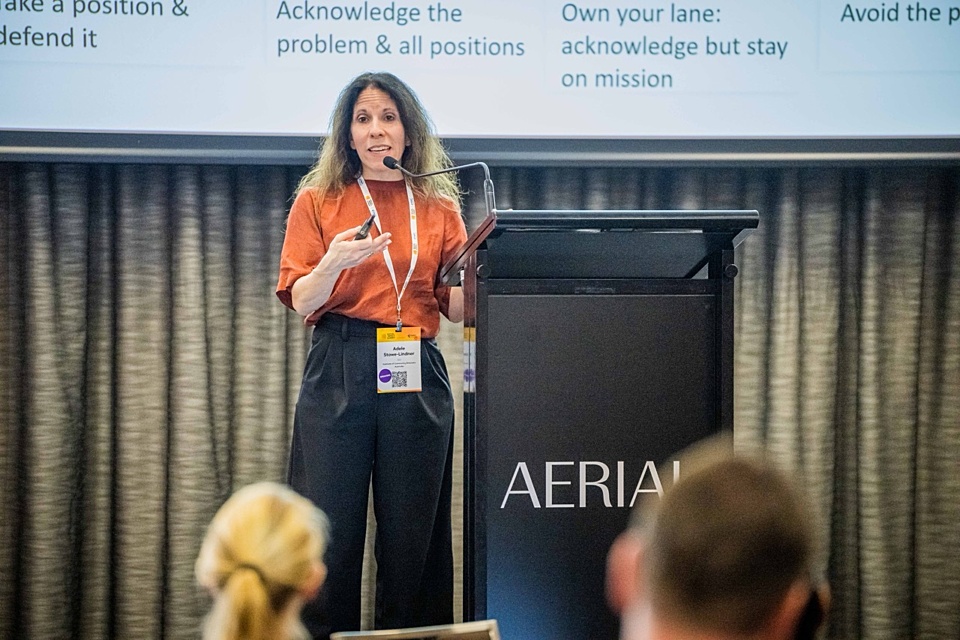
I spoke at the Social Impact Summit in Sydney this month on a topic that has been sitting with me for a while: what happens to the communities we serve when the organisations serving them lose sight of what they are actually there to do?
This usually does not happen overnight, but rather, gradually, in increments so small that no single step feels like a departure from anything.
The word “impact” is everywhere in our sector. It appears in funding applications, annual reports, board papers and strategic plans. It sits at the top of logic models and at the bottom of evaluation frameworks. We talk about impact measurement, impact investment, impact readiness, collective impact. We have, in many ways, made impact into a discipline.
Considering the noise around impact, how can impact become quietly displaced in the same organisations that are most loudly committed to it?
The threat to impact rarely announces itself as a threat. It usually comes dressed up as something else entirely: a funding opportunity that is adjacent to the mission, a staff member with a cause they care about deeply, or a public controversy that makes everyone in the room feel they should say something.
In each case, the people involved are not acting from bad faith. They are acting from genuine care. That is what makes it complicated and interesting.
When organisations drift, it is almost never because someone decided to stop caring about impact. It is because the care got redirected with good intentions, and no one noticed when impact stopped being the organisation’s reason for being.
"I do not think mission drift is simply a management failure: it is usually a governance problem."
My Social Impact Summit address was programmed as part of the People and Communities stream. I explored what impact means beyond “What does our strategy say?” or “What do our metrics show?” I wanted to explore impact as part of the answer to the question “Who are we actually here for?”.
That question has a unique answer in every organisation: an answer about which people, with which needs, in which circumstances, your organisation has made a commitment to serve.
When that question stays at the forefront of the board’s mind, and it is the question the board reaches for before any other, governance tends to hold. Decisions made in service of the answer to that question tend to be defensible, even when they are very difficult to make, because they are at the heart of the organisation’s mission.
When that question of purpose fades, the most vocal stakeholders, the most recent controversy, the most available funding or the most urgent internal pressure fill the gap. The people who bear the cost of the fading of purpose are rarely in the room when the decision gets made.

I do not think mission drift is simply a management failure: it is usually a governance problem. Boards hold the mission in trust. That is the legal and ethical weight of the role. A board that is doing its governance job is the structural safeguard that stands behind the communities that depend on consistent, purposeful work.
The communities we exist to serve did not choose us as board directors for our opinions on every contested question that enters the public conversation. They came to us, and depend on us, because of something specific we said we would do for them. Keeping faith with that commitment, particularly when pressure is high and the noise in the room is loud, is governance at its best.
At the Social Impact Summit, I explored four different ways organisations respond when the pressure is on: by defending a position, by acknowledging complexity without taking a side, by staying firmly bound by the mandate, or by avoiding the issue altogether. Each of those roads has costs and benefits, and my point was not to prescribe one over the others. The point was to notice when you are choosing, and when you are just reacting.
A leader who decides, after deliberate consideration, that their organisation’s mission requires them to speak publicly on a contested issue, and who can articulate why that is so, from purpose rather than from pressure, is doing something different from a leader who issues a statement because the organisational silence has become uncomfortable.
I also talked about the distinction between a public statement and an internal act of pastoral care. When a major external event causes distress to people inside your organisation, acknowledging that distress is not a political act. It is an act of leadership, and of basic human care. The fact that it sometimes gets tangled up with questions about public positioning is a failure of clarity, not an argument for silence. On the other hand, public positions are a question of governance.
Impact might bring to mind Excel spreadsheets, lists of numbers and maybe a qualitative survey. An important aspect of impact is the discipline of keeping the right questions alive, even when other questions are more exciting and more prominent in the news and social media.
The question of impact arises in board meetings when someone asks, before the agenda moves on: Does this decision actually serve the people we exist for? It arises in budget conversations when someone asks: Is this allocation moving us towards our mission, or away from it? It arises in the governance review that is honest about the organisation’s drift and clear about what is needed to correct course.
Questions about impact do not arise automatically. They require someone at the board table, ideally more than one person, to keep reaching for that question, someone who is trusted enough to be able to ask it without being treated as obstructive. They require a board culture that supports the asking.
I ended my session in Sydney with a reminder of the governance and impact question: Who are we actually here for? Not who are you accountable to, because accountability is distributed across any organisation and might include funders or a broader community. But who are you leading for? Whose lives are you there to make different, and in what specific way?
When that is clear, it doesn’t make the hard calls easy, but it might make contested issues simpler to work through. The course becomes navigable, steering becomes easier, and mission drift has been averted – again.
Download our FREE 42-page Measuring What Matters guide for a quick handle on evaluation principles and frameworks, outcomes and data gathering.
Then, visit the outcomes measurement section of our website for answers to '10 questions every board member needs to ask about measuring outcomes', evaluation templates, and data and privacy policies.
Find more resources in our tools and resources section.
Posted on 15 Oct 2026
Community Directors has a warehouse-style office filled with artworks, and if I glance up towards…

Posted on 17 Sep 2026
My father often googles my name, and as a result, years ago, I received a surprising gift in the…

Posted on 13 Aug 2026
As a teenager, I attended summer camp for seven years, first spending two weeks at a time camping…

Posted on 10 Jun 2026
There’s a line of thought about AI in the not-for-profit sector that goes something like this: “We…
Posted on 18 May 2026
Like your favourite T-shirt or the song you listen to when you’re feeling low, your organisation’s…

Posted on 15 Apr 2026
Lately I’ve been spending a lot of time in interview rooms.

Posted on 12 Mar 2026
I sat in a room with 1200 people at a fundraising event a few weeks ago, dressed nicely, feeling…

Posted on 10 Feb 2026
As my family dropped our teenage son off at the airport in the first week of January to embark on a…

Posted on 10 Dec 2025
The Institute of Community Directors Australia trains over 22,000 people each year, which gives us…

Posted on 12 Nov 2025
At the Institute of Community Directors Australia, we believe that stronger communities make a…
Posted on 11 Nov 2025
‘It’s not a question of enough, pal. It’s a zero-sum game. Somebody wins and somebody loses’.

Posted on 15 Oct 2025
The Institute of Community Directors Australia team sits physically and figuratively between two…