Why winning philanthropic support is complicated
Posted on 17 Sep 2026
Experts in Australian philanthropy say there are stark differences between philanthropic money and…
Posted on 12 Mar 2026
By Neil Pharaoh and Rory Parker, Tanck

If government were to give you a blank cheque for one million dollars tomorrow, what would you do with it? If you can’t answer this immediately, it’s time to start thinking about it.
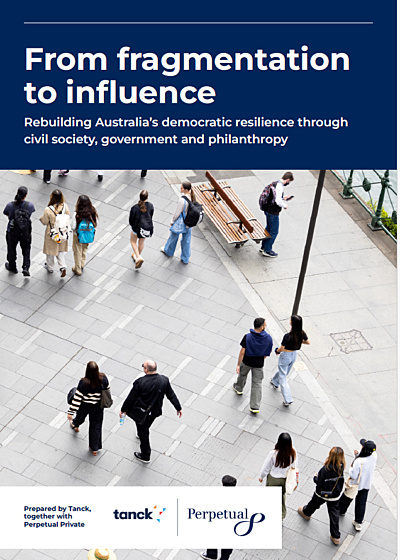
Seventy per cent of not-for-profits surveyed for the development of Tanck’s latest whitepaper, From Fragmentation to Influence: Rebuilding Australia’s democratic resilience through civil society, government and philanthropy, noted a significant reliance on government funding. We know that many of these, as well as many organisations in the remaining 30 per cent, are crying out for more funding from government. We hear this every day.
But what we also hear is that many don’t know why they want funding. Sure, some may have programs in mind, and others may be chasing capital works or operational pursuits, but a surprising number can’t answer the question from the top of this article.
This isn’t an indictment on these NFPs. Far from it. Through the development of our whitepaper, we heard how the state of funding for NFPs presently is a structural, not cyclical, crisis. Forty per cent of organisations reported being overstretched, which has led to 69 per cent of surveyed organisations only engaging government reactively, without strategy or proactivity. Ultimately, the need to focus efforts and resources on service delivery gets in the way of engagement – even though this may ultimately reduce organisational impact and influence.
"MPs are well connected: they know their communities, they know what’s happening in the media and political contexts, and they often know what’s happening in the social sector better than you would expect."

There’s no simple solution to this aside from setting it as a non-negotiable: strategic clarity is not a luxury; it is a survival tool.
As part of any strategic planning process, your organisation should already be considering or reviewing your problem–solution framework (that is, what is the problem that your organisation seeks to solve, and what is your solution?).
This informs your strategic planning process, which sets out where you want to get to and how you want to get there. So, as part of that process, overlay government engagement: do your problem and solution or strategy align with those of government? How could government support you to deliver this? It is important to recognise that government funding is fundamentally a strategic exercise before it is a political one.
From there, put yourself in a marketer’s shoes and visualise your solution as a ‘product’. Consider what it looks like, who benefits, where will it be delivered, and what will it cost (you would be surprised how many budget submissions don’t list the budget required!).
Ensuring your request for money is SMART (specific, measurable, achievable, relevant and time-bound) can help with developing parameters here. Politicians can work their way out of anything, so it’s important to be specific with what you need – specificity creates accountability and protects your outcome. For example, you should be able to say, ‘We need $X million to reach Y people in your area, with Z as the outcome.’
If you’re really struggling here in defining exactly what you want, funnily enough it can be MPs who can help you to break through. Briefing them on your work, your impact and your vision can open the door to asking them about government priorities and what they’ve been hearing as key challenges in your sector or community.
This can help kickstart a collaborative relationship where you work to solve a problem together. This is not to say you should go into a meeting without having established your strategy; rather, it's about finding shared values and common problems, and using your strengths to find a positive outcome.
MPs are well connected: they know their communities, they know what’s happening in the media and political contexts, and they often know what’s happening in the social sector better than you would expect. You aren’t outsourcing your solution to them: you’re looking to find shared values and strategic alignment, then translate that into collaboration.
Engagement is about intelligence gathering as much as it is about relationship-building.

As the state and federal governments’ conversations and negotiations surrounding their upcoming 2026–27 budgets are moving into their final stages, it’s an opportune time to start looking ahead. This includes considering the federal mid-year economic and fiscal outlook (MYEFO), referred to in some circles as the half-Budget, in November and December.
NFP leaders should also look ahead to the following year’s federal Budget, and the many grant and election opportunities that will arise in the meantime. Work on developing your strategy before refining it into priorities so that you’ve got “asks” ready to go if opportunities arise. If you’re only starting to build your submission when the budget portals open, unfortunately you’re already too late.
Often, analysis paralysis prevents organisations from getting started on their government engagement journey – asking MPs for something can feel daunting until you’ve done it once or twice. But this is why it is also so important to push through. Limit yourself to three to five priorities, map them out, and get engaging. The first step to getting funding from government is never about playing politics: it’s simply knowing what you want. Nine times out of ten, you’ll find that government backs precision, not principles and aspiration.
This article adapts content from Tanck and Perpetual’s new government engagement whitepaper, From Fragmentation to Influence: Rebuilding Australia’s democratic resilience through civil society, government and philanthropy. Read it in full here
Member offer: $99 webinar: Winning government attention in 2026
Posted on 17 Sep 2026
Experts in Australian philanthropy say there are stark differences between philanthropic money and…
Posted on 17 Sep 2026
Australia’s biggest gathering of philanthropists, which drew more than 1200 delegates to Brisbane…
Posted on 17 Sep 2026
One of Australia’s foremost fundraising observers says Australian not-for-profits must get the…

Posted on 17 Sep 2026
My father often googles my name, and as a result, years ago, I received a surprising gift in the…

Posted on 17 Sep 2026
Charities reported $14.8 billion in donations and bequests last financial year, the second-highest…
Posted on 17 Sep 2026
As direct giving dries up, charities face growing dependence on big donors and negotiating the…

Posted on 17 Sep 2026
Where Evelyn Mugisha grew up in rural Uganda, the subjects and careers considered suitable for…
Posted on 09 Sep 2026
Media attention about women's philanthropy has more than doubled in three years, according to new…
Posted on 09 Sep 2026
A global gathering of philanthropists in Brisbane this week is aiming to tackle society’s biggest…
Posted on 26 Aug 2026
Sector leader Violet Roumeliotis has called on funders to stop treating not-for-profit…

Posted on 13 Aug 2026
Innovation isn't just a buzzword, and it isn't just about technology. It’s a necessary part of…

Posted on 13 Aug 2026
Most new purpose-driven projects falter in the early phase because there’s no one assigned to the…